Lista esencial de verbos irregulares en Past Simple

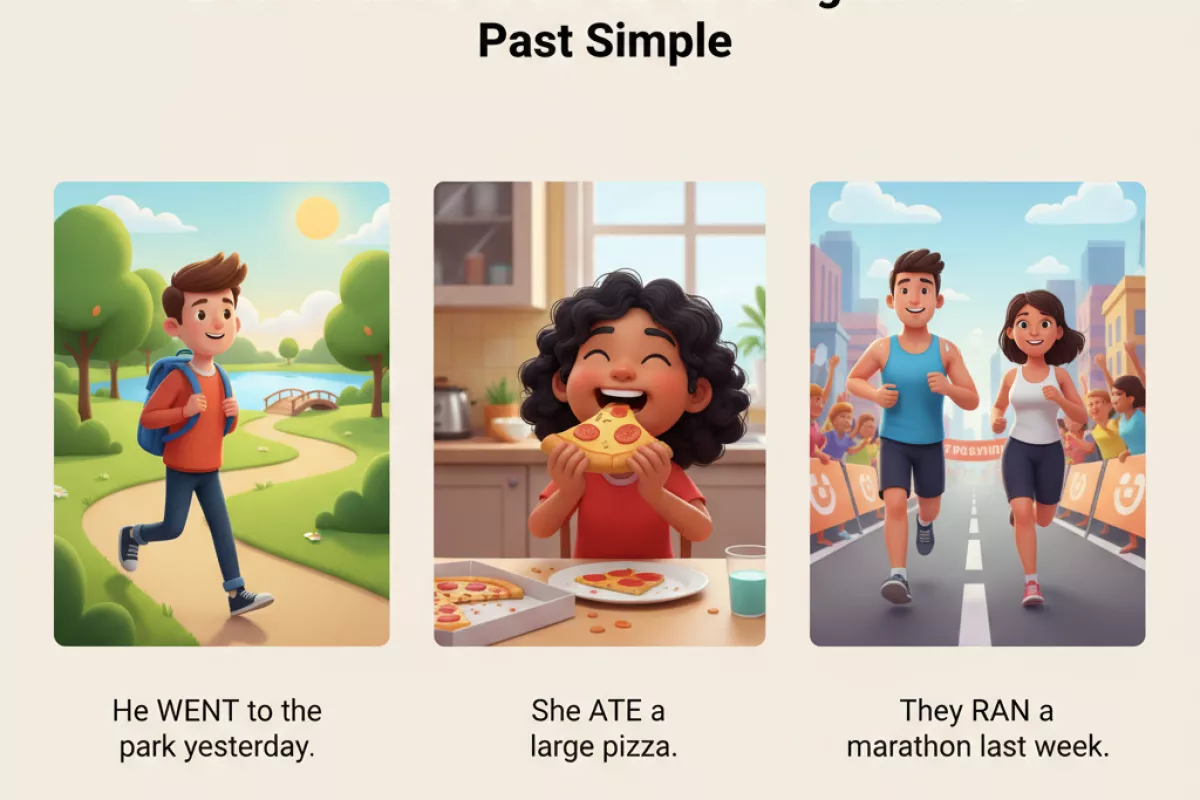 Aprende a usar una lista de verbos irregulares en Past Simple de forma práctica: empieza por los más frecuentes, reconoce patrones de cambio, evita errores con did y practica con ejemplos reales, mini ejercicios y respuestas.
- Cómo usar una lista de verbos irregulares de forma útil
- Lista esencial de verbos irregulares frecuentes
- Verbos irregulares con patrones fáciles
- Verbos con pasado igual a la forma base
- Negativas y preguntas con did
- Confusiones típicas: formas parecidas y falsos recuerdos
- Mini práctica rápida con verbos frecuentes
- Ejercicio práctico para casa
Los verbos irregulares en Past Simple no se aprenden bien solo mirando una lista larga. Lo importante es saber qué verbos aparecen con más frecuencia, qué patrones se repiten y cómo usarlos en frases reales. En esta guía verás una lista esencial, grupos fáciles de recordar, verbos cuyo pasado no cambia y ejemplos prácticos para evitar errores como goed, buyed o Did you went?.
Respuesta rápida: los verbos irregulares en Past Simple no forman el pasado con -ed. Algunos cambian mucho: go → went, otros cambian poco: feel → felt, y otros no cambian: cut → cut. En negativas y preguntas, se usa did + verbo base: Did you go?, I didn’t see it.
Cómo usar una lista de verbos irregulares de forma útil
Una lista de verbos irregulares no debería usarse solo para memorizar de arriba abajo. Funciona mejor como una herramienta de consulta y práctica dentro del uso del Past Simple. La idea es aprender cada verbo con una frase corta, reconocer su patrón y comprobar si en pasado cambia mucho, cambia poco o no cambia.
Para que la lista sea realmente útil, conviene trabajar en tres pasos: primero reconocer la forma base, luego aprender el pasado y finalmente usarlo en una frase completa. Así no memorizas formas sueltas, sino expresiones que puedes usar al hablar de ayer, de la semana pasada o de una historia terminada.
Rutina práctica: de la lista a la frase
- Selecciona 10 o 15 verbos frecuentes y no intentes aprender 100 de golpe.
- go → went
- buy → bought
- take → took
- see → saw
- Aprende cada verbo con una frase ancla, no como palabra aislada.
- I went home early. (Me fui a casa temprano.)
- She bought a new phone. (Ella compró un teléfono nuevo.)
- They took the wrong bus. (Ellos tomaron el autobús equivocado.)
- Agrupa los verbos por patrón para que la memoria trabaje con familias.
- Sin cambio: cut → cut, put → put, hit → hit
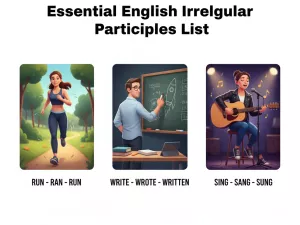
- Cambio de vocal: begin → began, drink → drank, sing → sang
- Terminación parecida: buy → bought, think → thought, catch → caught
- Marca los verbos peligrosos, porque suelen confundirse por sonido, forma o significado.
- say → said vs tell → told
- make → made vs do → did
- teach → taught vs learn → learned/learnt
- Practica con marcadores de pasado, porque ayudan a situar la frase.
- Marcadores como yesterday, last y ago suelen acompañar al Past Simple: yesterday, last night, two days ago, in 2019.
Correcto e incorrecto desde el principio
Un error común es aprender la forma afirmativa, pero olvidar que en negativas y preguntas con did el verbo vuelve a la forma base. Este punto tendrá su propio bloque más adelante, pero conviene verlo desde el inicio.
| Tipo de frase | Correcto | Incorrecto |
|---|---|---|
| Afirmativa | She bought a phone. → Ella compró un teléfono. |
She buyed a phone. |
| Negativa | She didn’t buy a phone. → Ella no compró un teléfono. |
She didn’t bought a phone. |
| Pregunta | Did they take the bus? → ¿Tomaron el autobús? |
Did they took the bus? |
Nota de uso: en diccionarios de aprendizaje como Oxford Learner’s Dictionaries y Cambridge Dictionary, los verbos irregulares suelen presentarse con sus formas principales: base form, past simple y past participle. Para esta guía nos centramos en la forma base y el Past Simple, porque es lo que necesitas para contar acciones terminadas.
Lista esencial de verbos irregulares frecuentes
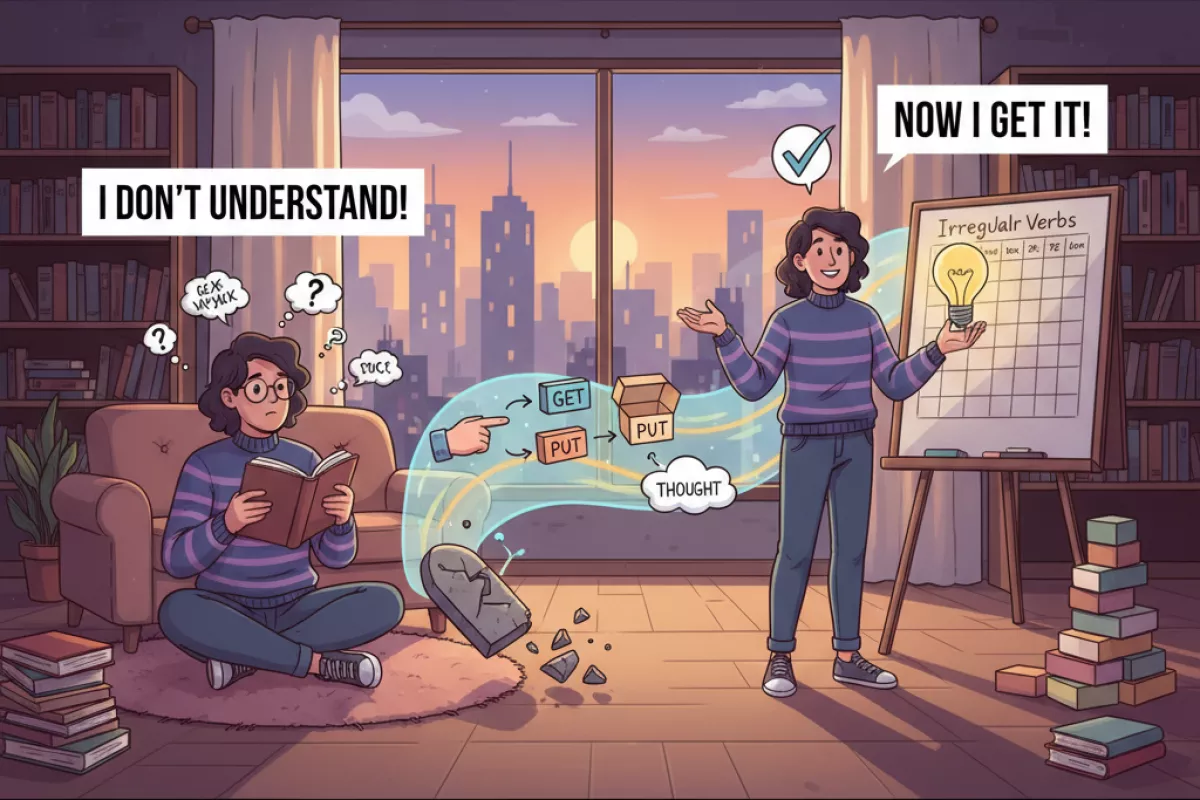
Para empezar, no necesitas aprender todos los verbos irregulares del inglés. Es más útil dominar primero los que aparecen constantemente en conversaciones, textos, series, noticias y ejercicios de nivel básico e intermedio. Estos verbos permiten contar acciones simples del pasado: qué hiciste, dónde fuiste, qué viste, qué compraste o qué dijiste.
La siguiente lista se centra en verbos irregulares frecuentes con su forma base y su forma en Past Simple. Si después quieres comparar el pasado simple con experiencias conectadas con el presente, puedes revisar la guía de Present Perfect vs Past Simple.
| Verbo base | Past Simple | Ejemplo breve |
|---|---|---|
| be | was / were | I was tired. → Estaba cansado. |
| have | had | We had dinner. → Cenamos. |
| do | did | She did her homework. → Ella hizo su tarea. |
| say | said | He said hello. → Él dijo hola. |
| go | went | They went home. → Fueron a casa. |
| get | got | I got your message. → Recibí tu mensaje. |
| make | made | We made a mistake. → Cometimos un error. |
| know | knew | I knew the answer. → Sabía la respuesta. |
| think | thought | She thought about it. → Ella pensó en eso. |
| take | took | He took the bus. → Él tomó el autobús. |
| see | saw | I saw the film. → Vi la película. |
| come | came | She came late. → Ella llegó tarde. |
| want | wanted | I wanted a coffee. → Quería un café. |
| give | gave | He gave me a book. → Me dio un libro. |
| find | found | We found the keys. → Encontramos las llaves. |
| tell | told | She told me the truth. → Ella me dijo la verdad. |
| work | worked | He worked yesterday. → Él trabajó ayer. |
| call | called | She called her mother. → Ella llamó a su madre. |
| try | tried | I tried again. → Lo intenté otra vez. |
| ask | asked | They asked a question. → Hicieron una pregunta. |
| need | needed | We needed more time. → Necesitábamos más tiempo. |
| feel | felt | I felt sick. → Me sentí enfermo. |
| become | became | He became angry. → Se enfadó. |
| leave | left | They left early. → Se fueron temprano. |
| put | put | She put it here. → Ella lo puso aquí. |
| mean | meant | I meant that. → Quise decir eso. |
| keep | kept | He kept the receipt. → Guardó el recibo. |
| let | let | They let us in. → Nos dejaron entrar. |
| begin | began | The class began. → La clase empezó. |
| seem | seemed | It seemed easy. → Parecía fácil. |
| help | helped | He helped me. → Él me ayudó. |
| talk | talked | We talked for an hour. → Hablamos durante una hora. |
| turn | turned | She turned left. → Ella giró a la izquierda. |
| start | started | The film started late. → La película empezó tarde. |
| show | showed | He showed me the photo. → Me mostró la foto. |
| hear | heard | I heard a noise. → Oí un ruido. |
| play | played | They played football. → Jugaron al fútbol. |
| run | ran | He ran fast. → Corrió rápido. |
| move | moved | They moved to Madrid. → Se mudaron a Madrid. |
| live | lived | She lived in Valencia. → Ella vivió en Valencia. |
| bring | brought | She brought food. → Ella trajo comida. |
| write | wrote | I wrote an email. → Escribí un correo. |
| sit | sat | We sat near the door. → Nos sentamos cerca de la puerta. |
| stand | stood | He stood outside. → Él estuvo de pie afuera. |
| lose | lost | I lost my wallet. → Perdí mi cartera. |
| pay | paid | She paid the bill. → Ella pagó la cuenta. |
| meet | met | I met your brother. → Conocí a tu hermano. |
| include | included | The price included breakfast. → El precio incluía el desayuno. |
| continue | continued | We continued the lesson. → Continuamos la lección. |
| set | set | He set the alarm. → Puso la alarma. |
| learn | learned / learnt | I learned a new word. → Aprendí una palabra nueva. |
| hold | held | She held my hand. → Ella me tomó de la mano. |
| lead | led | He led the team. → Él lideró el equipo. |
| understand | understood | We understood the rule. → Entendimos la regla. |
| read | read | I read it yesterday. → Lo leí ayer. |
| spend | spent | We spent a lot. → Gastamos mucho. |
| grow | grew | The plant grew fast. → La planta creció rápido. |
| win | won | They won the match. → Ganaron el partido. |
| buy | bought | I bought a ticket. → Compré una entrada. |
| send | sent | She sent a message. → Ella envió un mensaje. |
| build | built | They built a house. → Construyeron una casa. |
| fall | fell | He fell down. → Se cayó. |
| cut | cut | She cut the paper. → Ella cortó el papel. |
| break | broke | I broke my phone. → Rompí mi teléfono. |
| choose | chose | We chose the blue one. → Elegimos el azul. |
Nota: en verbos como put, let, set, cut y read, la forma escrita puede ser igual en presente y pasado. El contexto de la frase ayuda a entender el tiempo.
Cómo estudiar la lista sin bloquearte
- Empieza por los verbos que usas todos los días: go, have, do, make, see, take, get.
- Di una frase corta con cada uno: I went home, I had dinner, I saw him.
- No intentes memorizar solo columnas: la forma se fija mejor cuando aparece en contexto.
- Repite con marcadores de pasado: yesterday, last night, two days ago.
Verbos irregulares con patrones fáciles
Muchos verbos irregulares parecen difíciles porque no siguen -ed, pero varios forman grupos bastante reconocibles. Si aprendes los patrones, la lista deja de parecer aleatoria: ves que algunos verbos no cambian, otros cambian una vocal y otros comparten terminaciones como -ought o -aught.
La clave es no aprenderlos solo por orden alfabético. Es más práctico aprender mini-familias: buy → bought, bring → brought, think → thought; o sing → sang, drink → drank, begin → began.
Patrones comunes para aprender por grupos
| Patrón | Verbos | Ejemplo en Past Simple |
|---|---|---|
| Sin cambio | cut → cut, put → put, hit → hit | I cut the paper yesterday. |
| Cambio de vocal corto | get → got, sit → sat, run → ran | He ran home. |
| -ought / -aught | buy → bought, think → thought, catch → caught | She bought a new bag. |
| i → a | sing → sang, drink → drank, begin → began | The class began at nine. |
| ee → e | meet → met, feed → fed, bleed → bled | I met her last week. |
| Final en -t | feel → felt, keep → kept, sleep → slept | He slept badly. |
| ow/aw → ew | know → knew, grow → grew, draw → drew | I knew the answer. |
Patrones con ejemplos completos
- buy → bought: I bought a new phone. (Compré un teléfono nuevo.)
- bring → brought: She brought her laptop. (Ella trajo su portátil.)
- think → thought: We thought it was easy. (Pensamos que era fácil.)
- teach → taught: He taught English in 2020. (Él enseñó inglés en 2020.)
- feel → felt: I felt tired after work. (Me sentí cansado después del trabajo.)
- keep → kept: She kept the receipt. (Ella guardó el recibo.)
- send → sent: I sent an email. (Envié un correo.)
- build → built: They built a house. (Ellos construyeron una casa.)
Nota de variante: algunas formas pueden variar por región y estilo. Por ejemplo, learned y learnt son formas aceptadas, aunque learned es más común en inglés americano y learnt es frecuente en inglés británico.
Verbos con pasado igual a la forma base
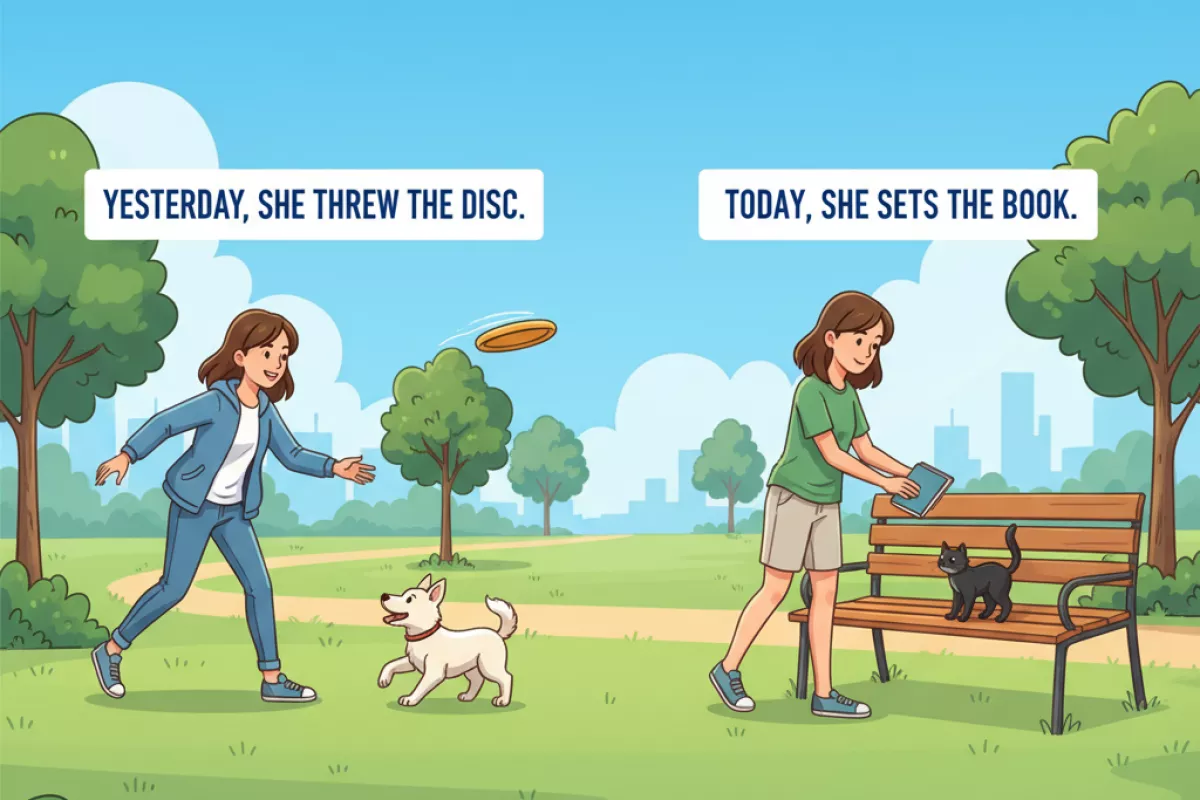
Algunos verbos irregulares tienen la misma forma en presente y en Past Simple. Esto puede parecer fácil, pero también provoca errores porque muchos estudiantes intentan añadir -ed por inercia: cutted, putted, hitted. En estos verbos, el pasado se entiende por el contexto o por los marcadores de tiempo.
Por ejemplo, en I cut the paper yesterday, sabemos que la acción está en pasado por yesterday, no porque el verbo cambie. Lo mismo ocurre con put, hit, set o cost.
Verbos frecuentes que no cambian en Past Simple
| Verbo | Ejemplo correcto | Error que debes evitar |
|---|---|---|
| cut | I cut the paper yesterday. → Corté el papel ayer. |
I cutted the paper. |
| hit | The ball hit the window. → La pelota golpeó la ventana. |
The ball hitted the window. |
| hurt | My knee hurt after the match. → Me dolió la rodilla después del partido. |
My knee hurted. |
| let | They let us leave early. → Nos dejaron salir temprano. |
They letted us leave. |
| put | She put the keys on the table. → Ella puso las llaves sobre la mesa. |
She putted the keys. |
| set | He set the alarm for 6 a.m. → Puso la alarma para las 6 a. m. |
He setted the alarm. |
| shut | She shut the door quietly. → Ella cerró la puerta en silencio. |
She shutted the door. |
| split | We split the bill. → Dividimos la cuenta. |
We splited the bill. |
| spread | The news spread fast. → La noticia se difundió rápido. |
The news spreaded fast. |
| burst | The balloon burst suddenly. → El globo explotó de repente. |
The balloon bursted. |
| cost | The tickets cost $20. → Las entradas costaron 20 dólares. |
The tickets costed $20. |
Cómo reconocer el pasado si el verbo no cambia
- Mira el marcador de tiempo: yesterday, last week, in 2020, two days ago.
- Mira el contexto de la historia: si todo el relato está en pasado, el verbo sin cambio también se entiende como pasado.
- No añadas -ed por inercia: en estos verbos, la forma correcta ya está completa.
Nota práctica: algunos verbos pueden tener variantes regulares en ciertos usos o variedades del inglés, pero para nivel básico conviene memorizar primero las formas más frecuentes y seguras: cut, put, hit, set y cost.
Negativas y preguntas con did
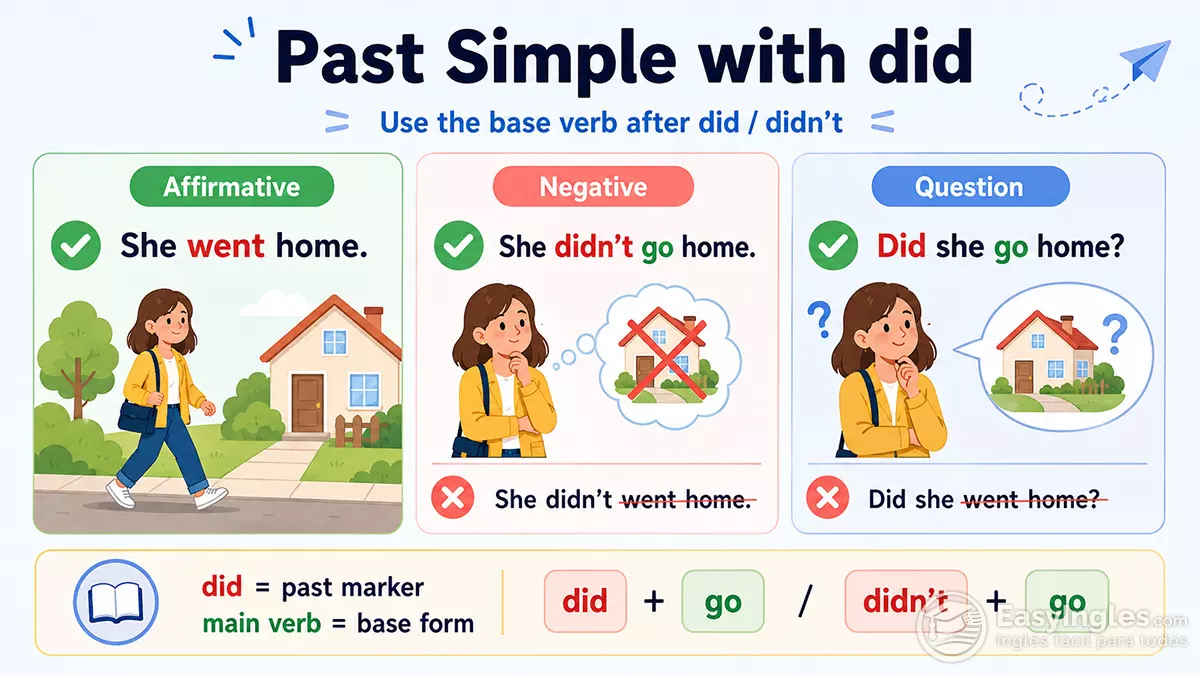
Una de las reglas más importantes del Past Simple es que la forma irregular se usa en afirmativas, pero no después de did o didn’t. En preguntas y negativas, el pasado lo marca el auxiliar did, y el verbo principal vuelve a la forma base.
Por eso decimos She went home, pero She didn’t go home y Did she go home?. El error aparece cuando el estudiante intenta poner el pasado dos veces: una en did y otra en el verbo principal. Para ampliar esta estructura, puedes revisar la guía sobre did en Past Simple.
Regla clave: en afirmativa usas el pasado irregular: She went. En negativa y pregunta, el pasado lo lleva did, y el verbo principal vuelve a la base: She didn’t go, Did she go?.
La estructura básica
| Tipo de frase | Estructura | Ejemplo correcto | Error frecuente |
|---|---|---|---|
| Afirmativa | Sujeto + pasado | I saw him yesterday. | I seed him yesterday. |
| Negativa | Sujeto + didn’t + base | I didn’t see him yesterday. | I didn’t saw him yesterday. |
| Pregunta | Did + sujeto + base? | Did you see him yesterday? | Did you saw him yesterday? |
| Respuesta corta | Yes/No + sujeto + did/didn’t | Yes, I did. / No, I didn’t. | Yes, I saw. |
Ejemplos con verbos irregulares frecuentes
- She bought a ticket. → She didn’t buy a ticket. → Did she buy a ticket?
- They took the bus. → They didn’t take the bus. → Did they take the bus?
- He wrote an email. → He didn’t write an email. → Did he write an email?
- We found the keys. → We didn’t find the keys. → Did we find the keys?
- I knew the answer. → I didn’t know the answer. → Did I know the answer?
Errores que debes evitar
- No pongas el verbo en pasado después de did.
- Incorrecto: Did you went home?
- Correcto: Did you go home?
- No uses didn’t + pasado irregular.
- Incorrecto: She didn’t bought it.
- Correcto: She didn’t buy it.
- No confundas respuesta corta con verbo principal.
- Incorrecto: Did you see it? Yes, I saw.
- Correcto: Did you see it? Yes, I did.
Confusiones típicas: formas parecidas y falsos recuerdos
Muchos errores con los verbos irregulares no vienen de no estudiar, sino de mezclar formas parecidas. A veces el estudiante recuerda un patrón real, pero lo aplica al verbo equivocado: bring no es bought, think no es fought, y wear no es were.
La forma más práctica de corregir esto es estudiar parejas peligrosas: verbos que se parecen por sonido, escritura o traducción. Algunas parejas también cambian de estructura, no solo de pasado. Un caso muy común es la diferencia entre say y tell.
Verbos que se confunden por forma o sonido
| Confusión típica | Forma correcta en Past Simple | Ejemplo correcto |
|---|---|---|
| buy / bring | buy → bought | I bought a new phone. (Compré un teléfono nuevo.) |
| buy / bring | bring → brought | She brought the documents. (Ella trajo los documentos.) |
| teach / tell | teach → taught | He taught me English. (Él me enseñó inglés.) |
| teach / tell | tell → told | They told us the truth. (Nos dijeron la verdad.) |
| think / thank | think → thought | I thought about it. (Lo pensé.) |
| think / thank | thank → thanked | We thanked her for the help. (Le dimos las gracias por la ayuda.) |
| wear / be | wear → wore | She wore a red jacket. (Llevó una chaqueta roja.) |
| wear / be | be → was/were | They were at home. (Estaban en casa.) |
| rise / raise | rise → rose | Prices rose last year. (Los precios subieron el año pasado.) |
| rise / raise | raise → raised | They raised prices. (Subieron los precios.) |
| lend / borrow | lend → lent | I lent him my book. (Le presté mi libro.) |
| lend / borrow | borrow → borrowed | She borrowed my charger. (Me pidió prestado el cargador.) |
| sit / set | sit → sat | He sat next to me. (Se sentó a mi lado.) |
| sit / set | set → set | She set the alarm. (Puso la alarma.) |
Falsos recuerdos frecuentes
- Confundir formas con -ought y -aught.
- buy → bought, bring → brought, think → thought, catch → caught.
- Error típico: bring → bought o think → fought.
- Añadir -ed a un irregular frecuente.
- Incorrecto: goed, buyed, taked, writed.
- Correcto: went, bought, took, wrote.
- Mezclar did con pasado irregular.
- Incorrecto: Did you saw it?
- Correcto: Did you see it?
- Olvidar que read se escribe igual, pero se pronuncia distinto.
- Presente: read /riːd/.
- Pasado: read /red/.
- Confundir left como pasado de leave con left = izquierda.
- He left early. (Se fue temprano.)
- Turn left. (Gira a la izquierda.)
Otra pareja que conviene aprender por contexto es make y do, porque no basta con traducir ambos como “hacer”. En pasado aparecen como made y did, pero también cambian según la expresión: made a mistake, did homework.
Mini práctica rápida con verbos frecuentes
La mini práctica sirve para entrenar lo esencial sin saturarte: forma afirmativa, negativa y pregunta. Trabaja con frases cortas, porque así detectas rápido si el verbo debe ir en pasado irregular o en forma base después de did.
Recuerda la regla antes de empezar: si no hay auxiliar, el verbo lleva la forma de pasado; si aparece did o didn’t, el verbo principal vuelve a la base.
Completa y corrige: 12 mini-ejercicios
- Completa la afirmativa con el pasado:
- I ____ (go) to work early. (Fui al trabajo temprano.)
- Completa la negativa con didn’t + base:
- She ____ ____ (see) the message. (Ella no vio el mensaje.)
- Completa la pregunta con Did + base:
- ____ you ____ (take) the keys? (¿Tomaste las llaves?)
- Elige la opción correcta:
- We had dinner at 8. (Cenamos a las 8.)
- We haved dinner at 8.
- Completa con el pasado correcto:
- They ____ (get) home late. (Llegaron a casa tarde.)
- Convierte a negativa:
- He bought a new phone. → He ____ ____ a new phone.
- Convierte a pregunta:
- You wrote the email. → ____ you ____ the email?
- Detecta y corrige el error:
- Did you went to the meeting?
- Completa con el pasado correcto:
- I ____ (make) a mistake. (Cometí un error.)
- Completa la negativa con didn’t:
- We ____ ____ (know) the answer. (No sabíamos la respuesta.)
- Elige la opción correcta:
- She said “sorry”. (Ella dijo “lo siento”.)
- She told “sorry”.
- Completa con el pasado correcto:
- He ____ (come) back yesterday. (Él volvió ayer.)
Mostrar respuestas
- I went to work early.
- She didn’t see the message.
- Did you take the keys?
- Correcto: We had dinner at 8.
- They got home late.
- He didn’t buy a new phone.
- Did you write the email?
- Did you go to the meeting?
- I made a mistake.
- We didn’t know the answer.
- Correcto: She said “sorry”.
- He came back yesterday.
Patrones rápidos para autocorrección
- Si ves did o didn’t, el verbo va en base.
- Did you see it?
- She didn’t buy it.
- Si no hay auxiliar, usa pasado.
- They took a taxi.
- I felt sick.
- Evita mezclar auxiliar y pasado.
- Incorrecto: We didn’t went home.
- Correcto: We didn’t go home.
Ejercicio práctico para casa
La práctica más útil con verbos irregulares consiste en reconocer patrones y aplicarlos en frases completas. No basta con recordar go → went: también necesitas usarlo bien en afirmativa, negativa y pregunta.
Antes de mirar las respuestas, revisa dos ideas: en afirmativa no se usa did, porque el verbo ya va en pasado; en negativa y pregunta, did lleva el tiempo y el verbo vuelve a su forma base.
Ejercicio 1: Completa con la forma correcta en Past Simple
- I ____ (go) to the office early.
- She ____ (buy) a new laptop.
- We ____ (have) dinner at 8.
- They ____ (take) the wrong bus.
- He ____ (write) three emails.
- You ____ (see) my message yesterday.
- My sister ____ (come) home late.
- The kids ____ (eat) all the cookies.
- Our team ____ (win) the match.
- I ____ (meet) your teacher last week.
- She ____ (make) a mistake.
- We ____ (find) the keys under the sofa.
Mostrar respuestas
- went
- bought
- had
- took
- wrote
- saw
- came
- ate
- won
- met
- made
- found
Ejercicio 2: Corrige las frases si es necesario
- Yesterday I goed to the gym.
- She didn’t went to class.
- Did you saw him last night?
- We took a taxi to the station.
- He didn’t buy anything.
- They writed a report.
- My parents came early.
- I didn’t knew the answer.
- Did she make dinner?
- We didn’t have time.
Mostrar respuestas
- Yesterday I went to the gym.
- She didn’t go to class.
- Did you see him last night?
- Correcta: We took a taxi to the station.
- Correcta: He didn’t buy anything.
- They wrote a report.
- Correcta: My parents came early.
- I didn’t know the answer.
- Correcta: Did she make dinner?
- Correcta: We didn’t have time.
Ejercicio 3: Pasa a negativa y a pregunta
- He drove to work.
- They found the address.
- She told the truth.
- You took my notebook.
- We chose the blue one.
- I understood the instructions.
Mostrar respuestas
- He didn’t drive to work. / Did he drive to work?
- They didn’t find the address. / Did they find the address?
- She didn’t tell the truth. / Did she tell the truth?
- You didn’t take my notebook. / Did you take my notebook?
- We didn’t choose the blue one. / Did we choose the blue one?
- I didn’t understand the instructions. / Did I understand the instructions?
Ejercicio 4: Agrupa por patrón
- go → went
- come → came
- become → became
- take → took
- write → wrote
- drive → drove
- see → saw
- eat → ate
- buy → bought
- think → thought
- bring → brought
- catch → caught
- have → had
- make → made
- meet → met
- feel → felt
Mostrar respuestas
- Grupo A: buy → bought, think → thought, bring → brought, catch → caught.
- Grupo B: come → came, become → became, write → wrote, drive → drove.
- Grupo C: go → went, take → took, see → saw, eat → ate.
- Grupo D: have → had, make → made, meet → met, feel → felt.
Resumen final
Para dominar los verbos irregulares en Past Simple, no memorices una lista enorme sin contexto. Empieza por los más frecuentes, agrúpalos por patrones y practica frases reales. Recuerda también la regla clave: en afirmativa usas la forma irregular, pero en negativas y preguntas con did el verbo principal vuelve a la forma base.