Superlativos en inglés: -est, most y least

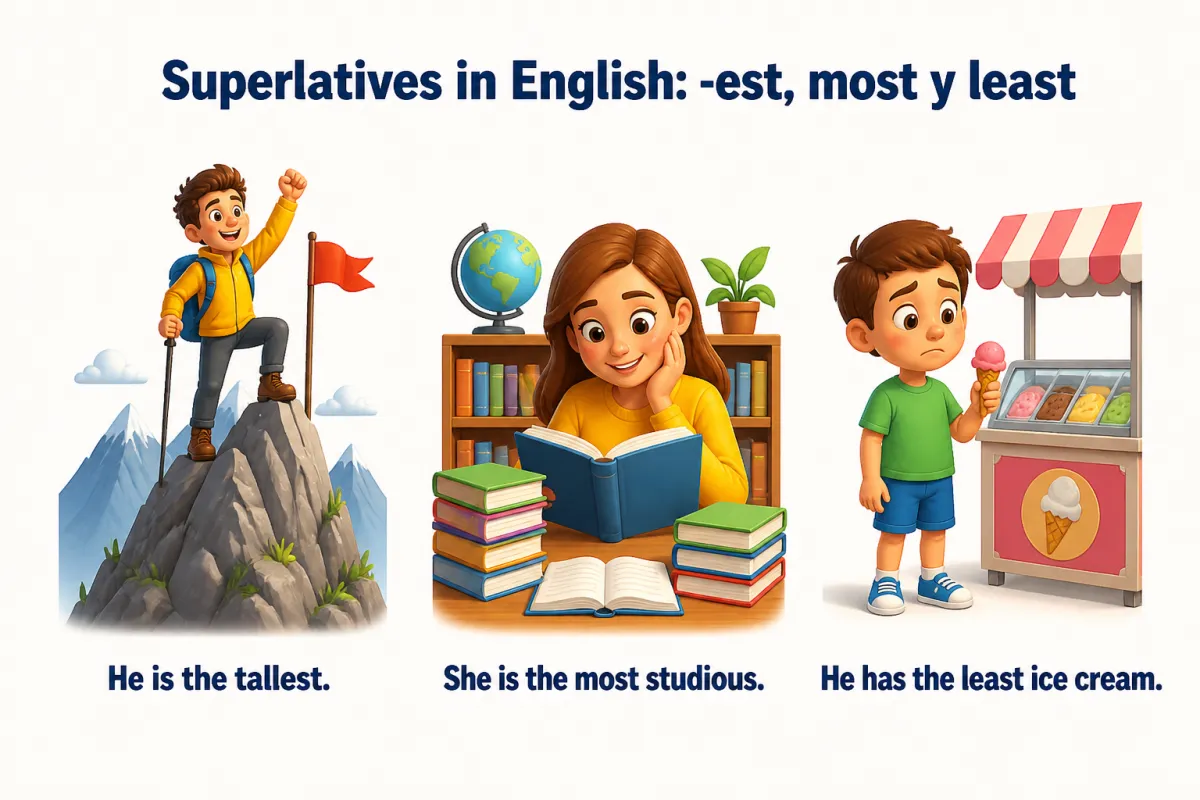 Resumen práctico de los superlativos en inglés: explica qué expresan, cuándo usar -est con adjetivos cortos, most con los largos y least para el grado más bajo. También muestra su uso con lugares, grupos y experiencias, la diferencia con el comparativo, errores comunes y práctica con frases, preguntas y respuestas.
- Qué expresa un superlativo en inglés
- Cuándo usar -est con adjetivos cortos
- Cuándo usar most con adjetivos largos
- Least para expresar el grado más bajo
- Superlativos con lugares, grupos y experiencias
- Diferencia entre comparativo y superlativo
- Errores al usar most y -est juntos
- Práctica: formar superlativos en frases completas
- Preguntas y respuestas
Para expresar en inglés que algo es lo más grande, lo menos útil o la opción más interesante, conviene dominar los superlativos, que se forman con terminaciones como -est o con palabras como most y least. Este tema suele entenderse mejor con ejemplos reales y situaciones cotidianas, porque así no solo memorizas una regla, sino que aprendes a usarla con naturalidad al hablar y al escribir.
Qué expresa un superlativo en inglés
Cuando usamos un superlativo, señalamos que una persona, cosa, lugar o experiencia tiene el grado más alto o más bajo dentro de un grupo. No estamos comparando dos elementos, sino uno frente a todos los demás de su categoría. Por eso suele aparecer con ideas como “de la clase”, “del equipo”, “de la ciudad” o “que he probado”.
En inglés, los superlativos más comunes se forman con -est, most y least. Además, casi siempre llevan the, porque hablamos de algo único dentro de ese grupo: the tallest student, the most interesting book, the least expensive option. Si quieres repasar mejor cuándo usar ese artículo, te puede ayudar esta explicación sobre el uso de the.
- Mount Everest is the highest mountain in the world. — El Everest es la montaña más alta del mundo.
- This is the most useful app on my phone. — Esta es la aplicación más útil de mi teléfono.
- It was the least stressful exam of the semester. — Fue el examen menos estresante del semestre.
- Julia is the fastest runner in our group. — Julia es la corredora más rápida de nuestro grupo.
Una buena forma de reconocer un superlativo es preguntarte: “¿Estoy diciendo que algo es el número uno o el último dentro de un conjunto?” Si la respuesta es sí, probablemente necesitas una forma superlativa.
Nota del profesor: muchos estudiantes entienden la regla, pero fallan en el contexto. Si en tu frase solo aparecen dos elementos, normalmente no necesitas un superlativo, sino un comparativo.
Cuándo usar -est con adjetivos cortos
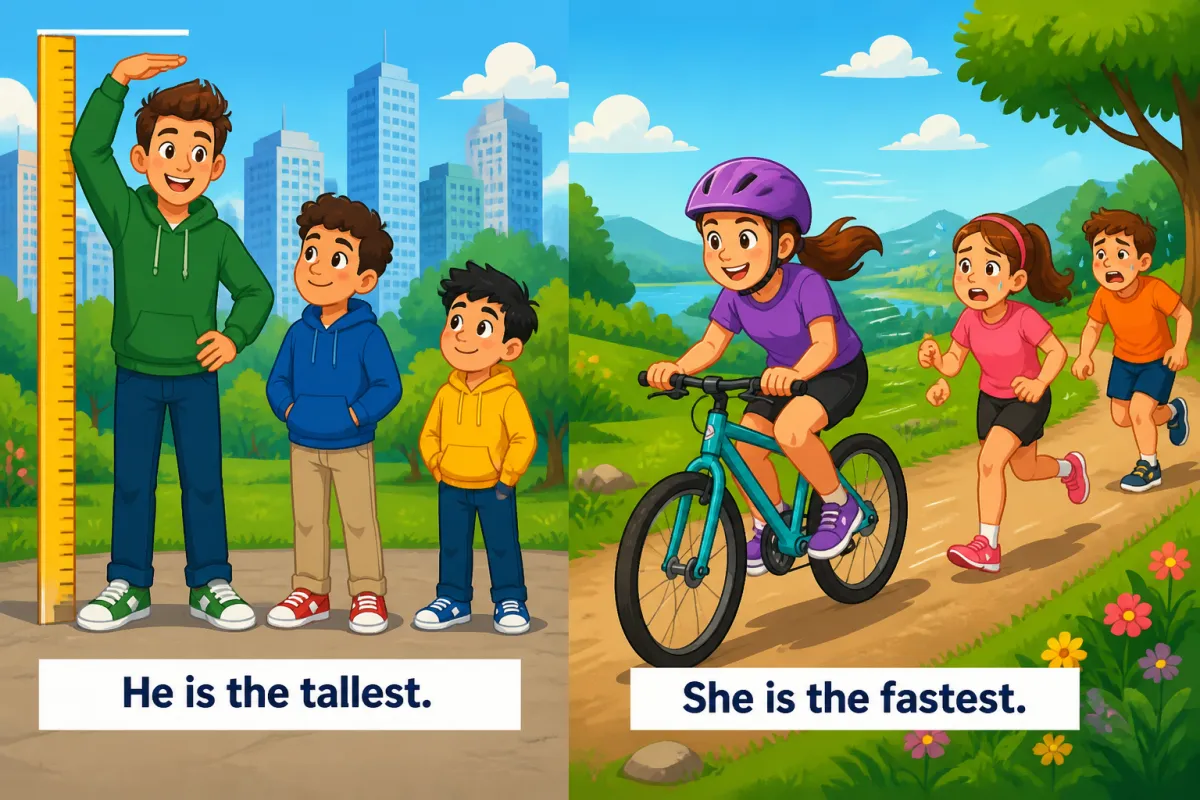
Con muchos adjetivos cortos, el superlativo se forma añadiendo -est. Esto suele ocurrir con adjetivos de una sílaba: tall, small, fast, long, cheap. También ocurre con algunos de dos sílabas que terminan en -y, como happy, easy o busy, aunque en esos casos hay un pequeño cambio ortográfico.
La idea principal es sencilla: si el adjetivo es corto, el inglés prefiere una forma compacta. Decimos the tallest, the longest, the easiest. Para muchos estudiantes, la dificultad no está en la regla básica, sino en los cambios de escritura y en saber cuáles son realmente “cortos” en uso normal.
| Tipo de adjetivo | Forma base | Superlativo | Ejemplo |
|---|---|---|---|
| 1 sílaba | tall | the tallest | Leo is the tallest boy in his class. |
| 1 sílaba | fast | the fastest | This train is the fastest one on this route. |
| 1 sílaba + e | nice | the nicest | She was the nicest person at the office. |
| Consonante-vocal-consonante | big | the biggest | That is the biggest screen in the store. |
| 2 sílabas en -y | happy | the happiest | Today is the happiest day of my year. |
| 2 sílabas en -y | easy | the easiest | This was the easiest question in the test. |
Fíjate en estos patrones ortográficos frecuentes:
- Si termina en -e, solo añadimos -st: nice → nicest.
- Si termina en consonante + vocal + consonante, normalmente doblamos la consonante final: big → biggest, hot → hottest.
- Si termina en -y, la y cambia a i: happy → happiest.
Estos contrastes ayudan a ver cómo funciona frente a otras formas:
- Tom is the tallest player on the team. — Tom es el jugador más alto del equipo.
- This backpack is the lightest one I found. — Esta mochila es la más ligera que encontré.
- Monday was the busiest day at the clinic. — El lunes fue el día más ocupado en la clínica.
Y aquí conviene ver diferencias que suelen confundir:
- My desk is smaller than yours. — Mi escritorio es más pequeño que el tuyo.
- My desk is the smallest in the room. — Mi escritorio es el más pequeño de la habitación.
- Her route is longer than mine. — Su ruta es más larga que la mía.
- Her route is the longest in the district. — Su ruta es la más larga del distrito.
- This task is easier than the last one. — Esta tarea es más fácil que la anterior.
- This task is the easiest in the workbook. — Esta tarea es la más fácil del cuaderno.
Cuándo usar most con adjetivos largos
Cuando el adjetivo es más largo, normalmente no añadimos -est. En su lugar, usamos the most delante del adjetivo: the most interesting, the most comfortable, the most expensive. Esta es la forma normal con muchos adjetivos de dos sílabas y con la mayoría de los de tres o más sílabas.
La dificultad real aquí no es memorizar “adjetivo largo = most”, sino desarrollar oído para distinguir los casos dudosos. Por ejemplo, algunos adjetivos de dos sílabas pueden variar según el uso, pero para un estudiante conviene empezar por una regla práctica: si suena largo o visualmente es largo, usa most. Si quieres profundizar en esta diferencia, puedes revisar la explicación sobre adjetivos largos.
- This is the most interesting chapter in the book. — Este es el capítulo más interesante del libro.
- That hotel was the most comfortable place we stayed in. — Ese hotel fue el lugar más cómodo en el que nos alojamos.
- She gave the most helpful answer in the meeting. — Ella dio la respuesta más útil en la reunión.
- It was the most confusing email I received all week. — Fue el correo más confuso que recibí en toda la semana.
También es importante no mezclar esta forma con la de los adjetivos cortos. No decimos most tall o most fast. En inglés, cada adjetivo suele “elegir” una estructura. Esa consistencia hace que la frase suene natural.
| Adjetivo | Superlativo correcto | Ejemplo |
|---|---|---|
| interesting | the most interesting | This was the most interesting lecture today. |
| careful | the most careful | Nina is the most careful driver in the family. |
| expensive | the most expensive | That is the most expensive dish on the menu. |
| popular | the most popular | It became the most popular video on the channel. |
| difficult | the most difficult | Question 8 was the most difficult one. |
| reliable | the most reliable | This brand is the most reliable option for long trips. |
Observa estos pares para afinar la diferencia entre comparativo y superlativo con adjetivos largos:
- This sofa is more comfortable than the old one. — Este sofá es más cómodo que el viejo.
- This sofa is the most comfortable in the store. — Este sofá es el más cómodo de la tienda.
- Her explanation was more detailed than mine. — Su explicación fue más detallada que la mía.
- Her explanation was the most detailed in the report. — Su explicación fue la más detallada del informe.
- The blue model is more practical for travel. — El modelo azul es más práctico para viajar.
- The blue model is the most practical option for business trips. — El modelo azul es la opción más práctica para viajes de trabajo.
Nota del profesor: si dudas entre dos formas, intenta decir la frase en voz alta. Muchas veces “the comfortablest” o “the interestest” suenan tan extrañas que el propio oído te empuja hacia “the most comfortable” o “the most interesting”.
Least para expresar el grado más bajo
No todo superlativo habla de “el más”. A veces necesitamos expresar “el menos”. Para eso usamos the least + adjetivo. Es una estructura muy útil porque sirve con adjetivos cortos y largos sin complicaciones: the least useful, the least noisy, the least attractive, the least risky.
En la práctica, least aparece mucho cuando comparamos opciones, evaluamos decisiones o damos opiniones matizadas. En el trabajo, por ejemplo, puedes decir cuál es la propuesta menos clara. En un viaje, cuál fue la parte menos cómoda. En un examen, cuál pregunta parecía menos directa.
- This route is the least dangerous at night. — Esta ruta es la menos peligrosa por la noche.
- That was the least useful comment in the discussion. — Ese fue el comentario menos útil de la discusión.
- Of all the candidates, he seemed the least prepared. — De todos los candidatos, él parecía el menos preparado.
- Sunday is usually the least busy day here. — El domingo suele ser el día menos ocupado aquí.
Es importante no confundir least con una negación total. Si digo “the least expensive”, no significa necesariamente “barato”; significa que, dentro de ese grupo, es el que cuesta menos.
- This laptop is expensive, but it’s the least expensive one in the catalog. — Este portátil es caro, pero es el menos caro del catálogo.
- Her presentation was not bad; it was just the least engaging of the four. — Su presentación no estuvo mal; simplemente fue la menos atractiva de las cuatro.
- The red chair is not uncomfortable, but it’s the least comfortable in the office. — La silla roja no es incómoda, pero es la menos cómoda de la oficina.
También conviene distinguirlo de otras ideas parecidas:
- I am less tired today than yesterday. — Hoy estoy menos cansado que ayer.
- I am the least tired person in the group. — Soy la persona menos cansada del grupo.
- This exercise is less confusing than the last one. — Este ejercicio es menos confuso que el anterior.
- This exercise is the least confusing in the unit. — Este ejercicio es el menos confuso de la unidad.
- The second plan is less risky than the first one. — El segundo plan es menos arriesgado que el primero.
- The second plan is the least risky of all. — El segundo plan es el menos arriesgado de todos.
Superlativos con lugares, grupos y experiencias

Una de las áreas donde más se usan los superlativos es al hablar de sitios, conjuntos de personas y vivencias personales. Ahí aparecen expresiones muy naturales como “the best restaurant in town”, “the oldest building in the area” o “the most exciting trip I’ve ever taken”. Si te acostumbras a estos marcos, empezarás a usarlos con mucha más facilidad en conversación y escritura.
Fíjate en la estructura: normalmente hay un nombre principal y luego una referencia al grupo o al contexto. Esa referencia suele introducirse con in, of o una oración relativa. El superlativo queda más claro cuando el grupo está bien definido.
- It’s the quietest street in the neighborhood. — Es la calle más tranquila del barrio.
- She is the most experienced engineer on the project. — Ella es la ingeniera con más experiencia del proyecto.
- That was the best meal of our trip. — Esa fue la mejor comida de nuestro viaje.
- This is the most beautiful beach I’ve ever seen. — Esta es la playa más bonita que he visto en mi vida.
- He’s the least talkative person in our office. — Es la persona menos habladora de nuestra oficina.
Con lugares, suele funcionar muy bien in:
- This is the safest area in the city. — Esta es la zona más segura de la ciudad.
- It’s the most crowded station in the region. — Es la estación más concurrida de la región.
- That café is the cheapest place in the center. — Ese café es el lugar más barato del centro.
Con grupos, es muy común of o una expresión de pertenencia:
- Marta is the most organized of the three assistants. — Marta es la más organizada de las tres asistentes.
- This was the hardest of all the interviews. — Esta fue la más difícil de todas las entrevistas.
- Ben is the friendliest person in my class. — Ben es la persona más amable de mi clase.
Con experiencias personales, una estructura muy natural es the + superlative + noun + I’ve ever...:
- That was the funniest movie I’ve ever watched with my family. — Esa fue la película más divertida que he visto con mi familia.
- It was the most exhausting week I’ve ever had at work. — Fue la semana más agotadora que he tenido en el trabajo.
- This is the least convincing excuse I’ve ever heard. — Esta es la excusa menos convincente que he escuchado jamás.
Nota del profesor: cuando practiques, no hagas solo frases sueltas del tipo “Tom is the tallest”. Añade siempre el grupo: in the class, of my friends, I’ve ever tried. Eso te obliga a pensar como en inglés real.
Diferencia entre comparativo y superlativo
La diferencia clave es muy concreta: el comparativo compara dos elementos; el superlativo destaca uno dentro de un grupo. Si dices “más alto que”, estás comparando dos. Si dices “el más alto de la clase”, estás señalando una posición extrema dentro de varios.
Muchos errores aparecen porque en español a veces cambiamos de una idea a otra sin notarlo, pero en inglés la estructura debe corresponder exactamente al sentido. Si en la frase hay “than”, casi seguro vas por comparativo. Si hay “in the class”, “of the team” o “I’ve ever seen”, normalmente necesitas superlativo. Si quieres reforzar la base antes de seguir, conviene revisar los comparativos básicos.
Aquí tienes contrastes claros en pares:
- Anna is taller than her sister. — Anna es más alta que su hermana.
- Anna is the tallest girl in her family. — Anna es la chica más alta de su familia.
- This bag is more practical than the black one. — Este bolso es más práctico que el negro.
- This bag is the most practical one in the shop. — Este bolso es el más práctico de la tienda.
- Today is less busy than yesterday. — Hoy está menos ocupado que ayer.
- Today is the least busy day of the week. — Hoy es el día menos ocupado de la semana.
Otros tres pares muy útiles para evitar confusiones:
- My train was faster than yours. — Mi tren fue más rápido que el tuyo.
- My train was the fastest of the morning. — Mi tren fue el más rápido de la mañana.
- Her report is more detailed than mine. — Su informe es más detallado que el mío.
- Her report is the most detailed in the department. — Su informe es el más detallado del departamento.
- This room is quieter than the kitchen. — Esta habitación es más silenciosa que la cocina.
- This room is the quietest in the house. — Esta habitación es la más silenciosa de la casa.
Un truco práctico: busca la lógica de la comparación antes de formar la frase. Si comparas A con B, usa comparativo. Si sitúas A en la cima o en la parte más baja de un conjunto, usa superlativo.
Errores al usar most y -est juntos
Uno de los errores más típicos es intentar reforzar el superlativo usando dos marcas a la vez: most y -est. En inglés eso no funciona. No se dice most tallest, most easiest ni most cheapest. Debes elegir una sola forma: o the tallest o the most interesting, según el tipo de adjetivo.
Este error suele venir del español, porque a veces pensamos “más + adjetivo” y luego añadimos la terminación inglesa. Pero el sistema inglés no acumula ambas señales. Además, hay otros fallos cercanos: olvidar the, usar la forma comparativa en lugar de la superlativa o escoger mal entre adjetivo corto y largo. Para ver más casos parecidos, puedes consultar esta página sobre errores superlativos.
Error 1: usar most y -est al mismo tiempo
Este es el más frecuente, sobre todo al hablar rápido o traducir mentalmente.
- ❌ She is the most tallest student in the class.
✅ She is the tallest student in the class. — Ella es la estudiante más alta de la clase. - ❌ This is the most easiest exercise in the book.
✅ This is the easiest exercise in the book. — Este es el ejercicio más fácil del libro. - ❌ That was the most cheapest ticket available.
✅ That was the cheapest ticket available. — Ese era el billete más barato disponible.
Error 2: usar -est con adjetivos largos
Aquí el problema no es exceso, sino escoger el patrón equivocado.
- ❌ It was the interestest part of the documentary.
✅ It was the most interesting part of the documentary. — Fue la parte más interesante del documental. - ❌ She gave the carefullest answer.
✅ She gave the most careful answer. — Ella dio la respuesta más cuidadosa. - ❌ This is the beautifullest village in the area.
✅ This is the most beautiful village in the area. — Este es el pueblo más bonito de la zona.
Error 3: olvidar the en el superlativo
En inglés, lo normal es usar the delante del superlativo cuando hablamos de un elemento concreto dentro de un grupo. Muchos hispanohablantes lo omiten porque en español no pensamos en ese artículo de la misma manera. Si necesitas reforzar esta parte, también puede ayudarte repasar los artículos en inglés.
- ❌ He is tallest player on the team.
✅ He is the tallest player on the team. — Él es el jugador más alto del equipo. - ❌ This was most difficult question in the exam.
✅ This was the most difficult question in the exam. — Esta fue la pregunta más difícil del examen. - ❌ It is least expensive option.
✅ It is the least expensive option. — Es la opción menos cara.
Error 4: usar comparativo cuando el sentido pide superlativo
Esto pasa cuando el estudiante ve una comparación, pero no detecta que en realidad se está comparando un elemento con todo un grupo.
- ❌ Sara is smarter in the class.
✅ Sara is the smartest in the class. — Sara es la más inteligente de la clase. - ❌ This is better restaurant in the neighborhood.
✅ This is the best restaurant in the neighborhood. — Este es el mejor restaurante del barrio. - ❌ Monday is busier day of the week.
✅ Monday is the busiest day of the week. — El lunes es el día más ocupado de la semana.
Nota del profesor: cuando corrijas tus propios textos, busca tres señales de alarma: falta de the, mezcla de most con -est, y frases con “in the...” o “of the...” donde has puesto un comparativo.
Práctica: formar superlativos en frases completas
La mejor manera de dominar este tema es producir frases completas, no solo transformar adjetivos aislados. En una frase real tienes que decidir si el contexto pide -est, most o least, si necesitas the y qué grupo estás usando como referencia.
Debajo tienes tres bloques de práctica. Cada uno trabaja una habilidad distinta: elegir la forma correcta, reescribir oraciones y detectar errores. Intenta responder sin mirar las soluciones de inmediato. Si fallas, no memorices solo la respuesta: identifica por qué esa forma funciona.
Bloque 1: elegir la forma correcta
- Emma is the (tallest / most tall) student in her dance class.
- This is the (most useful / usefulest) tool on the website.
- Sunday is the (least busy / less busy) day of the week at our store.
- That was the (funniest / most funniest) story of the evening.
- It is the (most expensive / expensivest) hotel in the area.
- Of the three routes, this one is the (safest / most safest).
- He gave the (most honest / honestest) answer in the interview.
- This chair is the (least comfortable / comfortablest) one in the room.
- May was the (rainiest / most rainy) month last year.
- She is the (most reliable / reliablest) person on our team.
Mostrar respuestas
- the tallest
- the most useful
- the least busy
- the funniest
- the most expensive
- the safest
- the most honest
- the least comfortable
- the rainiest
- the most reliable
Bloque 2: reescribir o transformar
- Rewrite with a superlative: No student in the class is taller than Max.
- Rewrite with a superlative: This laptop is more powerful than all the others in the office.
- Rewrite with a superlative: No route is less direct than this one.
- Rewrite with a superlative: Mia sings better than anyone in the choir.
- Rewrite with a superlative: This chapter is more confusing than the rest of the book.
- Rewrite with a superlative: None of the options is cheaper than the basic plan.
- Rewrite with a superlative: Jake arrived later than everyone else.
- Rewrite with a superlative: Of all my friends, Nora is less talkative than the others.
- Rewrite with a superlative: No building in the town is older than the church.
- Rewrite with a superlative: This was more disappointing than any other result this season.
Mostrar respuestas
- Max is the tallest student in the class.
- This laptop is the most powerful one in the office.
- This route is the least direct one.
- Mia sings the best in the choir.
- This chapter is the most confusing in the book.
- The basic plan is the cheapest option.
- Jake arrived the latest.
- Nora is the least talkative of all my friends.
- The church is the oldest building in the town.
- This was the most disappointing result this season.
Bloque 3: encontrar y corregir el error
- This is the most fastest way to get there.
- She is smartest person in the department.
- That was the boringest part of the meeting.
- It is least practical solution for small teams.
- Of all the players, Dan is stronger.
- This is the most easiest app to use.
- Friday was busiest day of the month.
- He chose the most cheap option online.
- This beach is beautifulest in the region.
- My cousin is the less patient person I know.
Mostrar respuestas
- This is the fastest way to get there.
- She is the smartest person in the department.
- That was the most boring part of the meeting.
- It is the least practical solution for small teams.
- Of all the players, Dan is the strongest.
- This is the easiest app to use.
- Friday was the busiest day of the month.
- He chose the cheapest option online.
- This beach is the most beautiful in the region.
- My cousin is the least patient person I know.
Preguntas y respuestas
1. ¿Siempre se usa the con los superlativos?
En la gran mayoría de los casos, sí. Decimos the best, the tallest, the most useful, porque hablamos de algo único dentro de un grupo. Aun así, en usos más informales o especiales puede omitirse, por ejemplo en ciertos estilos de titulares o estructuras fijas, pero para un estudiante la regla segura es: usa the.
2. ¿Cómo sé si un adjetivo es corto o largo?
Como regla práctica, los de una sílaba suelen ir con -est: small → the smallest. Los de tres o más sílabas casi siempre van con the most: interesting → the most interesting. Los de dos sílabas son la zona más variable, pero muchos terminados en -y usan -est: happy → the happiest.
3. ¿Puedo usar least con adjetivos cortos?
Sí. Aunque los superlativos “positivos” cambian entre -est y most, para expresar el grado más bajo puedes usar the least con adjetivos cortos y largos: the least noisy, the least friendly, the least effective. Es una forma muy útil y bastante estable.
4. ¿Qué pasa con formas irregulares como good o bad?
Tienen superlativos especiales que no siguen las reglas normales. Los más importantes son: good → the best, bad → the worst, far → the farthest o the furthest. Conviene memorizarlos pronto porque aparecen muchísimo en conversación real.
5. ¿Cuál es la diferencia entre the latest y the last?
No significan exactamente lo mismo. The latest suele referirse a lo más reciente: the latest version — la versión más reciente. The last puede significar el último en orden final: the last train — el último tren. A veces se parecen, pero no siempre son intercambiables.
6. ¿Se puede usar un superlativo sin mencionar el grupo?
Sí, si el grupo se entiende por el contexto. Por ejemplo, en una tienda alguien puede decir: This one is the cheapest. — Este es el más barato. Aunque no se mencione “de todos los modelos”, el contexto lo deja claro. Aun así, cuando practiques, decir el grupo completo te ayudará a construir mejor la lógica de la frase.
7. ¿Por qué a veces veo most con participios o adjetivos terminados en -ed?
Porque funcionan como adjetivos largos: the most tired, the most bored, the most satisfied. Aunque algunos puedan sonar breves en español, en inglés se tratan normalmente como formas que piden most. Ejemplo: She was the most surprised person in the room. — Ella era la persona más sorprendida de la sala.
8. ¿Es mejor aprender reglas o expresiones completas?
Las dos cosas, pero las expresiones completas te dan más fluidez. No memorices solo biggest o most interesting. Aprende grupos reales: the biggest problem in the office, the most interesting part of the class, the least expensive option on the menu. Así te resultará mucho más fácil usarlos al hablar y escribir.