Before y after con Past Perfect: guía sin confusión

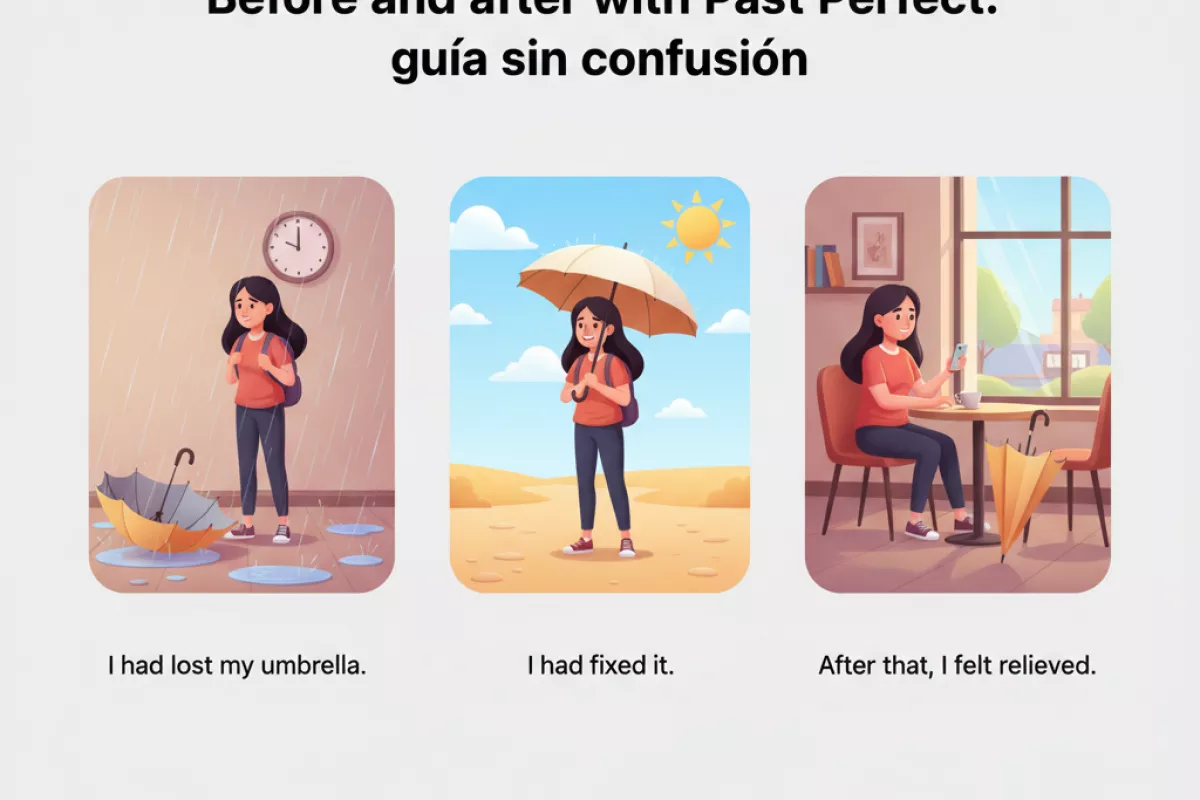 Aprende qué significan before y after en inglés y cómo marcan el orden lógico de los eventos. Verás cuándo es necesario usar el Past Perfect y cuándo es opcional, con ejemplos claros, errores frecuentes de interpretación, un truco práctico para elegir el tiempo verbal y ejercicios para practicar.
Cuando describes dos acciones en el pasado y necesitas dejar claro cuál ocurrió primero, es fácil confundirse con expresiones de tiempo y el Past Perfect. Esta guía te enseña a ordenar los hechos sin traducir literalmente, usando ejemplos naturales que aclaran el significado. El objetivo es que puedas contar historias, explicar causas y añadir contexto con seguridad, como en una conversación real.
Significado de before y after
En inglés, before y after sirven para ubicar acciones en el tiempo: indican qué ocurre primero y qué ocurre después. Su función principal es marcar el orden cronológico, ya sea con una palabra suelta, con una frase nominal (un sustantivo) o introduciendo una oración completa.
La idea clave es distinguir dos usos frecuentes: como preposiciones (van seguidas de un nombre o de una forma en -ing) y como conjunciones (van seguidas de una oración con sujeto + verbo). Esta diferencia ayuda a elegir la estructura correcta y evita errores típicos al combinar estos marcadores temporales con tiempos verbales como el Past Perfect.
Qué expresa cada uno
- before: indica anterioridad; algo sucede primero.
- after: indica posterioridad; algo sucede más tarde.
Patrones básicos (preposición vs. conjunción)
| Uso | Estructura | Ejemplo |
|---|---|---|
| Preposición | before/after + nombre | After dinner, we went for a walk. (cena) |
| Preposición | before/after + -ing | Before leaving, call me. (salir) |
| Conjunción | before/after + sujeto + verbo | After I arrived, I called you. (llegué) |
| Conjunción (con pasado) | before/after + oración en pasado | Before she left, she locked the door. (se fue) |
Ejemplos prácticos para reconocer la estructura
- Before the meeting, I reviewed my notes. (reunión)
- After the meeting, I sent the email. (correo)
- Before going to bed, he brushed his teeth. (dormir)
- After finishing the report, she took a break. (informe)
- Before we start, does anyone have questions? (empezar)
- After we started, the system crashed. (se colgó)
- Before I moved to Madrid, I lived in Valencia. (me mudé)
- After I moved, I changed my phone number. (me mudé)
- Before the flight, they checked their passports. (vuelo)
- After the flight, they picked up their luggage. (equipaje)
- Before signing the contract, read it carefully. (contrato)
- After signing, you will receive a copy. (firmar)
- Before the class, I always arrive early. (clase)
- After class, we usually grab coffee. (café)
Matices importantes que suelen causar confusión
- Orden en la frase: el bloque con before/after puede ir al inicio o al final sin cambiar el sentido principal. Ej.: After dinner, we talked / We talked after dinner.
- Coma al inicio: si la expresión va al principio, es común usar coma tras ese bloque: Before leaving, call me.
- Forma verbal tras preposición: si no hay sujeto + verbo, lo natural es usar -ing: After arriving, call me (llegar). No se usa infinitivo con to en ese lugar.
- Cuando ya está claro el orden: a veces, el tiempo verbal por sí solo aclara la secuencia; aun así, before/after se usa para enfatizar o evitar ambigüedad.
Orden lógico de los eventos
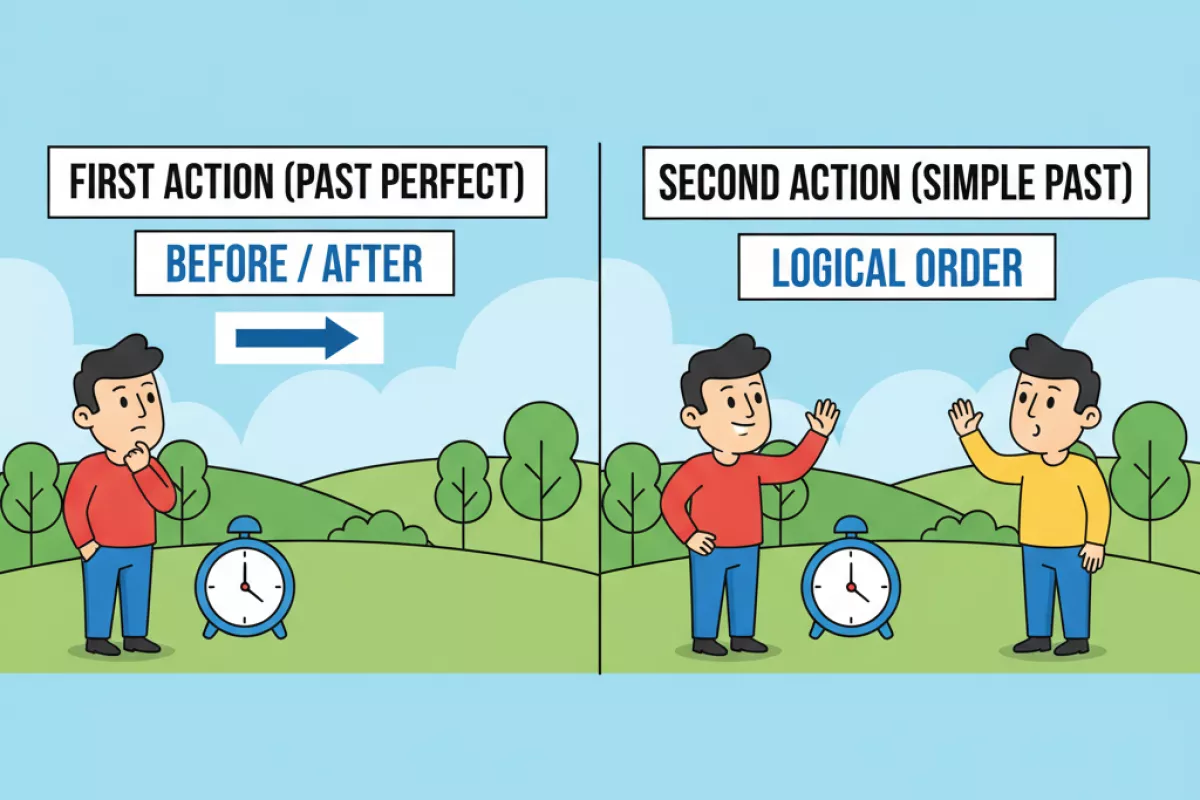
Cuando en una misma historia hay dos acciones pasadas, lo importante es indicar cuál ocurrió primero y cuál después. Para eso, el Past Perfect funciona como una “marca de anterioridad”: señala el evento que ya estaba completado antes de que ocurriera el otro hecho en pasado.
En la práctica, before y after ayudan a ordenar, pero no siempre obligan a usar Past Perfect. Se usa cuando quieres evitar ambigüedad o cuando el orden no es evidente solo con el contexto. La idea clave es: Past Perfect = el paso previo; Past Simple = el hecho posterior (dentro del pasado).
Regla operativa: qué tiempo va en cada parte
- After + evento anterior → suele ir en Past Perfect: After I had finished, I left.
- Before + evento posterior → suele ir en Past Simple: I left before he arrived.
- Si el orden ya está clarísimo (por fechas, por lógica o por un “then”), a veces basta con Past Simple en ambas partes.
Patrones típicos con “before” y “after”
| Estructura | Tiempo más común | Ejemplo |
|---|---|---|
| After + oración (acción 1), acción 2 | Past Perfect + Past Simple | After she had called, he answered. |
| Acción 2 + after + oración (acción 1) | Past Simple + Past Perfect | He answered after she had called. |
| Before + oración (acción 2), acción 1 | Past Simple + Past Perfect | Before he arrived, we had started. |
| Acción 1 + before + oración (acción 2) | Past Perfect + Past Simple | We had started before he arrived. |
| After + gerund (-ing) | Perfect -ing / Past Simple | After having finished (haber terminado), she left. |
| Before + gerund (-ing) | Past Simple / Perfect -ing | He checked the lock before leaving. |
Ejemplos claros (y por qué funcionan)
- After I had eaten, I felt better. (Primero comer, después sentirse mejor)
- I felt better after I had eaten. (Mismo orden, otra posición)
- Before the movie started, we had found our seats. (Primero encontrar asientos, luego empezar)
- We had found our seats before the movie started. (Se enfatiza que ya estaba hecho)
- After they had signed the contract, they announced the deal. (El anuncio depende de una acción previa)
- She apologized after she had realized her mistake. (La realización ocurre antes que la disculpa)
- Before he said anything, he had taken a deep breath. (Acción preparatoria anterior)
- They left after they had checked the tickets. (Verificación completada primero)
- Before we met, I had read your email. (Lectura previa al encuentro)
- After the train had departed, she noticed her bag. (El darse cuenta es posterior)
- He called me after he had spoken to the manager. (Conversación previa como requisito)
- Before the meeting ended, we had agreed on the budget. (Acuerdo ya cerrado antes del final)
Cuándo NO hace falta Past Perfect (aunque haya “before/after”)
- Cuando el orden es obvio por el significado: After he arrived, we started. (Llegar → empezar suele ser natural)
- Cuando hay marcadores temporales que fijan la secuencia: In 2019 we moved, and in 2020 we bought a house.
- Cuando solo narras pasos seguidos y no necesitas destacar el “ya había”: She opened the door and walked in.
Errores frecuentes que rompen la secuencia
- Usar Past Perfect para el evento posterior: After I went home, I had cooked. (Suena invertido: cocinar debería ir antes del resultado si se quiere marcar anterioridad)
- Olvidar que “before” introduce lo que ocurre después en el tiempo: I had left before he had arrived. (Puede ser posible, pero suele ser innecesario; normalmente basta con Past Perfect + Past Simple)
- Confundir “after” con “then”: “Then” solo encadena; “after” expresa relación temporal explícita y suele pedir más precisión si hay riesgo de confusión.
Cuándo el Past Perfect es opcional
Con before y after, muchas veces el orden de los hechos ya queda claro por la propia conjunción. En esos casos, el inglés puede usar Past Simple en ambas acciones sin perder el sentido, porque after marca “después” y before marca “antes”.
La idea práctica es esta: si el lector entiende sin esfuerzo qué ocurrió primero, el tiempo compuesto suele ser prescindible. Aun así, se mantiene como opción cuando quieres subrayar que una acción estaba completada antes de la otra, o cuando la frase se vuelve más larga y el orden podría interpretarse mal.
Patrones donde suele bastar el Past Simple
- After + Past Simple, Past Simple: After I finished work, I went home.
- Past Simple + after + Past Simple: I went home after I finished work.
- Before + Past Simple, Past Simple: Before I left, I locked the door.
- Past Simple + before + Past Simple: I locked the door before I left.
- Con acciones consecutivas y claras: After we ate, we watched a movie.
- En narración lineal (eventos en cadena): She called me after she arrived.
Cuándo el Past Perfect sigue siendo una buena elección (aunque no sea obligatorio)
Incluso cuando before o after ya ordenan los hechos, el tiempo compuesto aporta precisión: refuerza la idea de “acción ya completada” y ayuda cuando hay detalles intermedios, varios sujetos o interrupciones en la cronología.
| Situación | Sin Past Perfect | Con Past Perfect |
|---|---|---|
| Orden claro y frase corta | After he arrived, we started dinner. | After he had arrived, we started dinner. |
| Quieres enfatizar “ya” (acción completada) | Before I spoke to her, I read the email. | Before I spoke to her, I had read the email. |
| Frase larga con información intercalada | After she finished the report, which took hours, she sent it. | After she had finished the report, which took hours, she sent it. |
| Varios hechos pasados compiten por “qué fue primero” | He apologized after he said something rude. | He apologized after he had said something rude. |
| Resultado actual en el pasado (efecto ya establecido) | After they moved, the neighborhood changed. | After they had moved, the neighborhood changed. |
Señales típicas de que puedes omitirlo sin problema
- La oración tiene solo dos acciones y están unidas directamente por before o after.
- El contexto es una secuencia narrativa simple (primero A, luego B).
- No hay saltos temporales, aclaraciones largas ni incisos entre la acción y la consecuencia.
- El sujeto se mantiene y no hay riesgo de confundir quién hizo qué.
Ejemplos extra (opción A/B) para ver el matiz
- After I got the message, I called you. / After I had gotten the message, I called you.
- Before we started, we checked the equipment. / Before we started, we had checked the equipment.
- She left after she talked to the manager. / She left after she had talked to the manager.
- I saved the file before I closed the laptop. / I had saved the file before I closed the laptop.
- They ate after they arrived. / They ate after they had arrived.
- He checked in after he showed his ID (documento). / He checked in after he had shown his ID.
Ejemplos comparativos claros
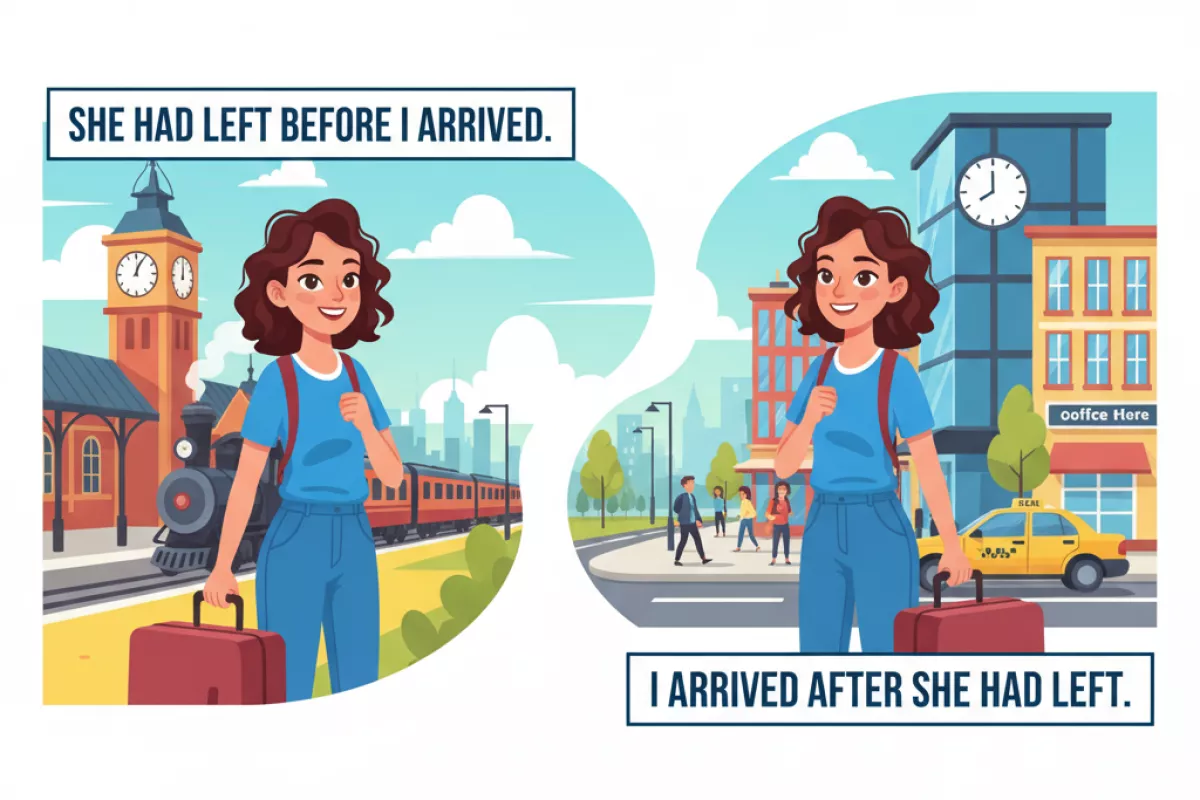
La manera más fiable de usar before y after con el pasado perfecto es pensar en dos momentos del pasado: un hecho anterior y otro posterior. El pasado perfecto (had + past participle) suele marcar el hecho anterior; el otro hecho normalmente va en pasado simple.
La clave práctica es esta: before y after ya expresan el orden, así que el pasado perfecto no es “obligatorio” en todos los casos. Aun así, se usa para evitar ambigüedad, para enfatizar qué ocurrió primero o cuando el contexto podría confundir el orden.
Comparaciones directas: pasado simple vs. pasado perfecto
| Conector | Sin pasado perfecto | Con pasado perfecto |
|---|---|---|
| before | I left before she arrived. | I left before she had arrived. |
| after | We ate after we finished the meeting. | We ate after we had finished the meeting. |
| before | He apologized before he spoke to the manager. | He apologized before he had spoken to the manager. |
| after | She felt better after she took the medicine. | She felt better after she had taken the medicine. |
| before | They checked in before they boarded. | They checked in before they had boarded. |
| after | I recognized him after I saw his ID. (carné) | I recognized him after I had seen his ID. (carné) |
Patrones que se repiten (y te ayudan a decidir)
- After + past perfect suele sonar natural cuando el segundo evento es la consecuencia: After we had signed the contract, we celebrated. (contrato)
- Before + past perfect aparece cuando se quiere subrayar que algo “ya había pasado” antes del segundo evento: She left before I had a chance to explain. (oportunidad)
- Si el orden es obvio por el contexto, el pasado simple en ambas cláusulas es suficiente: I locked the door before I went to bed.
- Si hay riesgo de confusión (dos acciones cercanas o narración rápida), el pasado perfecto aclara: He realized the email was wrong after he had sent it.
- Con verbos de “finalización” (finish, complete), el pasado perfecto encaja bien para marcar “ya terminado”: After they had finished, they turned off the lights.
- En estilo más informal, a menudo se omite el pasado perfecto con after si no hay ambigüedad: After we ate, we left.
Ejemplos listos para copiar (con orden temporal claro)
- After I had parked the car, I called you.
- After she had read the instructions, she started the test. (instrucciones)
- After they had discussed the issue, they made a decision. (tema)
- After we had booked the tickets, we checked the schedule. (horario)
- After he had saved the file, the computer crashed.
- After I had met her once, I remembered her name.
- Before I had finished my sentence, he interrupted me.
- Before she had studied the map, she got lost.
- Before they had agreed on a price, they stopped negotiating. (precio)
- Before we had reached the station, it started raining.
- I had already eaten before I arrived. (ya)
- She had left before the meeting started.
- We had never seen snow before we moved to Canada. (nieve)
- He had checked the address before he sent the package. (paquete)
- They had repaired the leak before the guests arrived. (fuga)
- I felt relieved after I had paid the bill. (factura)
Errores típicos al mezclar before/after y pasado perfecto
- Usar pasado perfecto en las dos cláusulas sin necesidad: After I had finished, I had gone home suele ser excesivo; normalmente: After I had finished, I went home.
- Confundir el participio: had went es incorrecto; es had gone (ir).
- Olvidar que before/after ya marcan el orden: si el contexto es claro, el pasado simple puede ser la opción más natural.
- Traducir literalmente estructuras del español: en inglés se prioriza la claridad temporal con had + participle cuando hay dos puntos del pasado en juego.
Errores típicos de interpretación
Cuando se combinan marcadores temporales como before y after con tiempos perfectos, el problema no suele ser la gramática “pura”, sino la lógica: qué acción ocurrió primero y cuál se usa como referencia. En inglés, estas palabras ya ordenan los hechos, así que el tiempo verbal elegido debe apoyar esa relación, no duplicarla ni contradecirla.
La idea clave es distinguir entre orden (lo marca before/after) y anterioridad (lo expresa el Past Perfect). Si el orden ya está claro, a menudo el Past Simple basta; si hay riesgo de ambigüedad o se quiere enfatizar que una acción estaba completada antes de otra pasada, entonces el Past Perfect aporta precisión.
Confundir el papel de “before/after” con el del tiempo verbal
- Error: usar Past Perfect “por obligación” cada vez que aparece before o after.
- Por qué pasa: se asume que “antes/después” siempre exige “pasado anterior”.
- Cómo corregirlo: si el conector ya ordena los eventos y no hay ambigüedad, el Past Simple puede ser suficiente.
Usar Past Perfect en la cláusula equivocada
- Patrón típico: poner Past Perfect en la acción “posterior” por inercia.
- Regla práctica: el Past Perfect suele ir en la acción que ocurrió primero (la “más antigua”) cuando se compara con otra acción en pasado.
- Ejemplo de corrección: After she had finished (terminado) the report, she sent it. (primero terminar, luego enviar)
Interpretar “after” como si significara “antes” por el Past Perfect
Un fallo frecuente es pensar que, si aparece Past Perfect, la frase “cambia” el significado de after. En realidad, after siempre marca que lo de su cláusula sucede primero y lo de la principal después; el Past Perfect solo refuerza que esa primera acción ya estaba completada.
- Lectura correcta: After he had left, we started the meeting. = primero se fue, luego empezamos.
- Evitar: “after + Past Perfect” no significa “antes de que…”, sigue siendo “después de que…”.
Mezclar “before” con una secuencia temporal incoherente
- Error: construir una frase donde el tiempo verbal contradice el orden que impone before.
- Señal de alerta: al traducir mentalmente, parece que “antes” y “después” se invierten.
- Solución: comprobar qué evento es el punto de referencia (el “pasado base”) y cuál ocurrió aún más atrás.
Creer que “before/after” obligan a dos tiempos distintos
En muchos contextos narrativos, el Past Simple en ambas cláusulas es natural porque el conector ya fija el orden. El Past Perfect se vuelve más útil cuando hay saltos en la historia, varias acciones pasadas compitiendo, o cuando se quiere enfatizar “ya había ocurrido”.
| Conector | Opción habitual | Cuándo usar Past Perfect |
|---|---|---|
| before | Past Simple + Past Simple | Si necesitas marcar claramente que una acción estaba completada antes del “pasado base”. |
| after | Past Simple + Past Simple | Si quieres enfatizar que la primera acción ya se había completado cuando ocurrió la segunda. |
| before | Past Perfect + Past Simple | Cuando el orden puede confundirse por la distancia entre ideas o por interrupciones en el relato. |
| after | Past Perfect + Past Simple | Cuando hay varias acciones previas y necesitas “anclar” cuál ocurrió primero. |
Errores de forma que cambian el sentido (o suenan poco naturales)
- Omitir el sujeto en una de las cláusulas: en inglés suele ser necesario repetirlo si no es el mismo referente.
- Confundir “after” con “afterwards”: after introduce una cláusula; afterwards es un adverbio (después).
- Usar “before” + -ing sin mantener la lógica temporal: Before leaving (antes de salir), he checked the lights. (la acción en -ing ocurre primero).
- Colocar “already” en una posición rara: suele ir entre auxiliar y participio: had already left (ya se había ido).
- Confundir “had” (auxiliar) con “would”: had left no expresa condición, expresa anterioridad.
- Capitalización innecesaria: before y after no se escriben con mayúscula salvo inicio de frase.
Mini-banco de patrones para comprobar tu interpretación
- After + Past Simple, Past Simple (orden claro, narración lineal).
- After + Past Perfect, Past Simple (énfasis en “ya había…”).
- Past Simple + after + Past Simple (misma idea, distinto orden en la frase).
- Before + Past Simple, Past Simple (orden claro por el conector).
- Before + Past Perfect, Past Simple (marcar anterioridad con más fuerza).
- Past Simple + before + Past Simple (útil para variar estilo).
- Before + -ing, Past Simple (acción en -ing ocurre primero).
- After + -ing, Past Simple (acción en -ing ocurre primero).
- It was only after + Past Perfect that + Past Simple (estructura de énfasis).
- By the time + Past Simple, Past Perfect (relación parecida, pero con “para cuando”).
Truco para elegir el tiempo correcto
La forma más fiable de escoger entre Past Perfect y Past Simple con before y after es pensar en una “línea de tiempo” con dos eventos pasados: uno ocurrió primero y el otro después. El tiempo verbal no se elige por la palabra (before/after) en sí, sino por cuál acción quieres marcar como anterior y cuál como la referencia.
En la práctica, usa el Past Perfect para “etiquetar” el evento que ya estaba completado cuando ocurrió el otro. Si el orden queda clarísimo solo por before o after, muchas veces el Past Simple en ambas partes suena natural; el Past Perfect se vuelve especialmente útil cuando quieres evitar ambigüedad o enfatizar que algo ya había pasado.
Regla rápida: identifica A (primero) y B (después)
- Paso 1: nombra los eventos como A (el más temprano) y B (el más tarde).
- Paso 2: decide qué evento quieres resaltar como “ya completado” cuando ocurre el otro.
- Paso 3: aplica el patrón:
- A = Past Perfect si quieres marcarlo como anterior “ya ocurrido”.
- B = Past Simple como el evento de referencia en el pasado.
Patrones típicos con before/after (y cuándo usar Past Perfect)
| Conector | Orden real | Patrón recomendado | Ejemplo |
|---|---|---|---|
| before | A ocurre antes que B | A en Past Perfect + B en Past Simple (si necesitas claridad/énfasis) | She had locked the door before she left. (cerró con llave antes de irse) |
| after | A ocurre antes que B | A en Past Perfect + B en Past Simple (si A debe quedar “ya hecho”) | After he had finished the report, he went home. (terminó el informe y luego se fue) |
| before | A ocurre antes que B | Past Simple + Past Simple (si el orden ya es obvio y no hay ambigüedad) | She locked the door before she left. |
| after | A ocurre antes que B | Past Simple + Past Simple (si suena natural y el orden es transparente) | After he finished the report, he went home. |
| before/after | El orden no es el foco | Evita Past Perfect si no aporta información; prioriza fluidez | We ate after we arrived. |
Checklist para decidir en 10 segundos
- ¿Hay dos acciones pasadas en la misma oración o en oraciones pegadas? Si sí, considera marcar la anterior.
- ¿Podría alguien interpretar el orden de otra manera? Si sí, el Past Perfect ayuda.
- ¿Quieres enfatizar “ya había ocurrido” (resultado previo) más que solo “ocurrió”? Si sí, usa had + past participle.
- Si before/after ya deja el orden cristalino y la frase suena natural, Past Simple en ambas cláusulas suele bastar.
- Si estás narrando una secuencia con varios pasos, reserva el Past Perfect para el “salto atrás” (cuando mencionas algo anterior al hilo principal).
Mini-banco de modelos (para copiar y adaptar)
- I had saved the file before I closed the laptop. (archivo)
- They had left before we arrived. (se fueron)
- After she had called him, she felt calmer. (más tranquila)
- After we had eaten, we went for a walk. (paseo)
- He had never flown before he moved abroad. (nunca)
- She had met him once before she started the job. (una vez)
- Before I had time to answer, he hung up. (colgó)
- After the train had left, we realized the mistake. (error)
- We checked the address before we ordered a taxi. (taxi)
- After I finished, I sent the email. (correo)
- She apologized after she realized what happened. (se dio cuenta)
- He turned off the lights before he went to bed. (a la cama)
- After they had signed the contract, they celebrated. (contrato)
- Before we started, we had agreed on the rules. (reglas)
Como criterio final: si al quitar el Past Perfect la oración mantiene el orden sin dudas, puedes quedarte con el Past Simple. Si al quitarlo aparece confusión sobre qué pasó primero, recupera had + past participle para fijar la cronología.
Ejercicios prácticos para casa
En estas actividades vas a practicar cómo ordenar dos acciones pasadas con before y after sin perder de vista qué ocurrió primero. La clave es fijarte en la secuencia real: la acción anterior suele ir en Past Perfect, y la posterior en Past Simple, especialmente cuando quieres dejar el orden totalmente claro.
Trabaja con atención a estos patrones: after + Past Perfect, Past Simple y Past Simple after + Past Perfect. Con before, es común ver Past Simple before + Past Simple cuando el orden ya se entiende, pero usar Past Perfect en la acción anterior ayuda a evitar ambigüedad.
Ejercicio 1: Completa con Past Perfect o Past Simple
- After I ________ (finish) my homework, I ________ (go) out.
- She ________ (leave) after she ________ (lock) the door.
- Before we ________ (start) the meeting, we ________ (check) the agenda.
- They ________ (eat) after they ________ (arrive) at the hotel.
- After he ________ (lose) his keys, he ________ (call) a locksmith.
- I ________ (not recognize) him because he ________ (change) his hairstyle.
- Before the movie ________ (begin), we ________ (buy) popcorn.
- After the train ________ (leave), we ________ (realize) we were on the wrong platform.
- She ________ (apologize) after she ________ (say) something rude.
- Before I ________ (send) the email, I ________ (read) it twice.
Mostrar respuestas
- After I had finished my homework, I went out.
- She left after she had locked the door.
- Before we started the meeting, we had checked the agenda.
- They ate after they had arrived at the hotel.
- After he had lost his keys, he called a locksmith.
- I didn’t recognize him because he had changed his hairstyle.
- Before the movie began, we had bought popcorn.
- After the train had left, we realized we were on the wrong platform.
- She apologized after she had said something rude.
- Before I sent the email, I had read it twice.
Ejercicio 2: Reescritura con “before/after” manteniendo el significado
- I had dinner. Then I watched a series.
- She finished the report. Then she sent it.
- They had booked the tickets. Then they went to the airport.
- He took a shower. Then he went to bed.
- We had met before. Then we realized we had the same teacher.
- I saved the file. Then the computer crashed.
- They arrived at the station. Then the train left.
- She had learned the rules. Then she started playing.
Mostrar respuestas
- After I had had dinner, I watched a series.
- After she had finished the report, she sent it.
- After they had booked the tickets, they went to the airport.
- After he had taken a shower, he went to bed.
- After we had met before, we realized we had the same teacher.
- After I had saved the file, the computer crashed.
- The train left after they had arrived at the station.
- After she had learned the rules, she started playing.
Ejercicio 3: Detecta y corrige el error
- After he arrived, he had called me.
- Before she had left, she packed her bag.
- After we had ate, we went for a walk.
- I went home after I had forgot my wallet.
- Before the class started, the teacher had explained the rules.
- After they had finished, they had went out.
- She didn’t go out because she has lost her phone.
- After I had seen the message, I was replying immediately.
Mostrar respuestas
- After he had arrived, he called me.
- Before she left, she had packed her bag.
- After we had eaten, we went for a walk.
- I went home after I had forgotten my wallet.
- Before the class started, the teacher explained the rules.
- After they had finished, they went out.
- She didn’t go out because she had lost her phone.
- After I had seen the message, I replied immediately.
Ejercicio 4: Elige la opción que mejor marca el orden
- After she ________, she turned off the lights.
1) left 2) had left - He apologized after he ________ something rude.
1) said 2) had said - Before we ________ the contract, we read it carefully.
1) signed 2) had signed - They didn’t recognize the city because it ________ a lot.
1) changed 2) had changed - After the match ________, we went for pizza.
1) ended 2) had ended - Before the guests ________, she had cleaned the house.
1) arrived 2) had arrived - I called you after I ________ the news.
1) heard 2) had heard - After he ________ the instructions, he started the test.
1) read 2) had read
Mostrar respuestas
- 2) had left
- 2) had said
- 1) signed
- 2) had changed
- 2) had ended
- 1) arrived
- 2) had heard
- 2) had read
Ejercicio 5: Ordena y construye la frase final
- (had / After / started / it / raining / we / went / home)
- (before / had / I / the / I / checked / sent / attachment / email)
- (she / after / had / called / finished / she / her / boss / the / meeting)
- (they / left / had / as soon as / they / heard / the / news)
- (before / began / the / we / presentation / had / prepared / slides / the)
- (he / didn’t / eat / after / he / had / cooked)
- (we / realized / after / had / the / train / left / we / arrived)
- (before / I / had / I / locked / checked / the / door / I / went / out)
Mostrar respuestas
- After it had started raining, we went home.
- Before I sent the email, I had checked the attachment.
- After she had finished the meeting, she called her boss.
- They left as soon as they had heard the news.
- Before the presentation began, we had prepared the slides.
- He didn’t eat after he had cooked.
- We realized after the train had left we had arrived.
- Before I went out, I had checked I had locked the door.