Ejercicios de Present Simple con soluciones

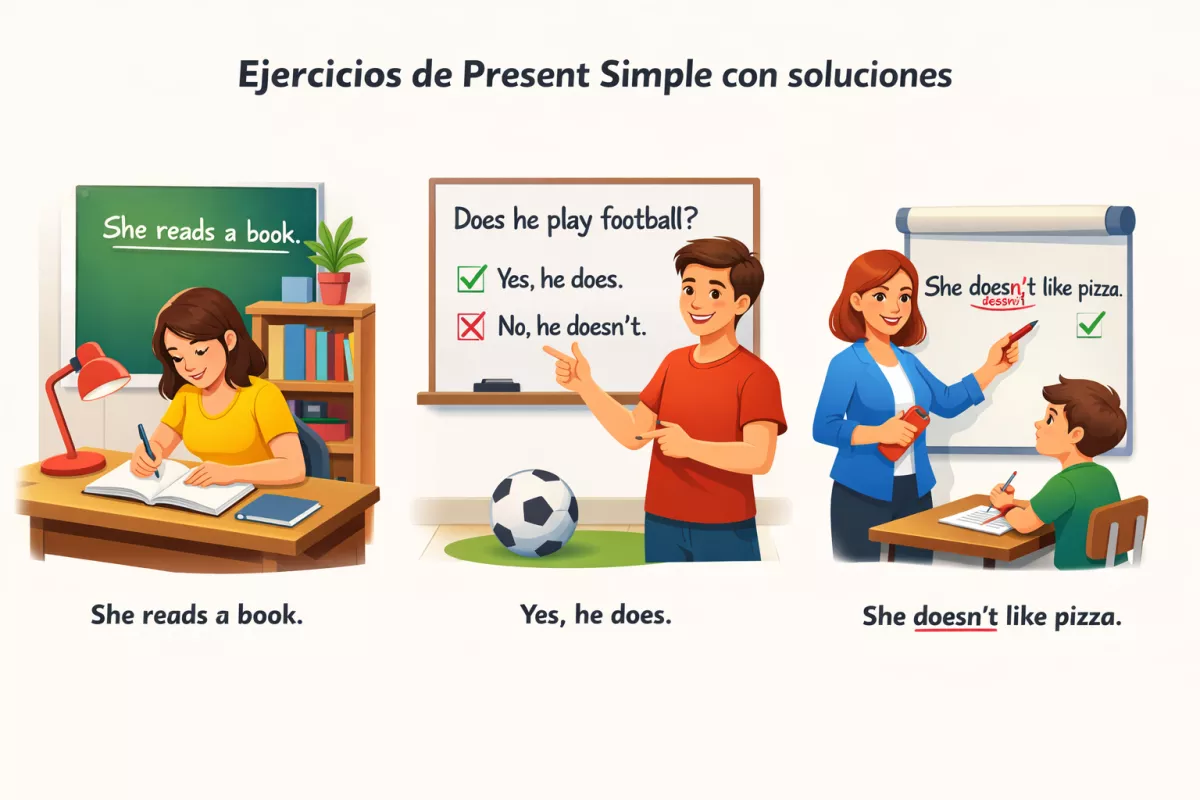 Incluye ejercicios de Present Simple con oraciones afirmativas, negativas y preguntas, además de práctica con adverbios de frecuencia, traducción de frases, corrección de errores comunes y estructuras mixtas. También trae soluciones explicadas paso a paso.
Aprender a hablar de rutinas, hechos y horarios en inglés es más sencillo cuando practicas con actividades claras y respuestas que te permitan comprobar cada paso. En este artículo trabajarás el presente simple en situaciones cotidianas, con ejemplos reales como I work, she studies o we live. No se trata de memorizar reglas aisladas, sino de entender cuándo y por qué se usa, para reconocerlo, escribirlo y emplearlo con mayor seguridad.
Ejercicios de afirmativas en presente
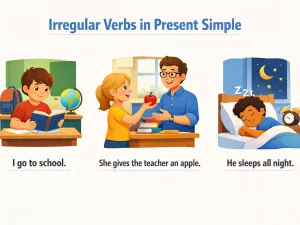
Las oraciones afirmativas en present simple son el punto de partida para dominar este tiempo verbal. Aquí lo importante no es solo recordar que usamos la forma base del verbo, sino fijarse muy bien en qué ocurre con he, she e it, porque ahí aparece la famosa terminación en -s o -es. Si este detalle se automatiza desde el principio, después las negativas y las preguntas resultan mucho más fáciles.
Te propongo una práctica progresiva: primero completar frases, luego transformar sujetos y, por último, producir oraciones completas. Así trabajas no solo la forma, sino también la lógica del idioma en situaciones reales: rutinas, horarios, gustos y hábitos.
Completa con la forma correcta del verbo
- I ______ (work) in an office.
- She ______ (study) English every day.
- They ______ (play) football on Saturdays.
- He ______ (watch) TV after dinner.
- We ______ (live) near the station.
- My brother ______ (go) to school by bus.
- You ______ (like) coffee.
- The dog ______ (sleep) in the kitchen.
- Anna and Leo ______ (read) a lot.
- It ______ (rain) a lot in winter.
Mostrar respuestas
- work
- studies
- play
- watches
- live
- goes
- like
- sleeps
- read
- rains
Reescribe cambiando el sujeto
- I play tennis on Sundays. → She
- They work in Madrid. → He
- We study at night. → My sister
- You drink tea in the morning. → Tom
- I go to the gym after work. → Laura
- They watch films on Fridays. → My father
- We have lunch at home. → Daniel
- You finish work at six. → Marta
- I wash the car every month. → My brother
- They do their homework after school. → She
Mostrar respuestas
- She plays tennis on Sundays.
- He works in Madrid.
- My sister studies at night.
- Tom drinks tea in the morning.
- Laura goes to the gym after work.
- My father watches films on Fridays.
- Daniel has lunch at home.
- Marta finishes work at six.
- My brother washes the car every month.
- She does her homework after school.
Consejo de profesor: si dudas con la tercera persona, no pienses en la regla aislada; piensa en una frase completa. El oído mejora mucho cuando practicas bloques enteros como “She works”, “He goes”, “It rains”.
Escribe la oración completa en afirmativa
- my parents / travel / every summer
- he / teach / maths at school
- we / start / work at eight
- the baby / cry / at night
- you / speak / very fast
- my aunt / cook / really well
- they / enjoy / long walks
- the train / leave / at 7:30
- she / clean / her room on Saturdays
- I / need / more time
Mostrar respuestas
- My parents travel every summer.
- He teaches maths at school.
- We start work at eight.
- The baby cries at night.
- You speak very fast.
- My aunt cooks really well.
- They enjoy long walks.
- The train leaves at 7:30.
- She cleans her room on Saturdays.
- I need more time.
| Sujeto | Patrón | Ejemplo |
|---|---|---|
| I / You / We / They | verbo base | They work every day. (Ellos trabajan cada día.) |
| He / She / It | verbo + s | She reads at night. (Ella lee por la noche.) |
| He / She / It | verbo + es | He watches TV. (Él ve la tele.) |
| He / She / It | y → ies | She studies English. (Ella estudia inglés.) |
Ejercicios de negativas
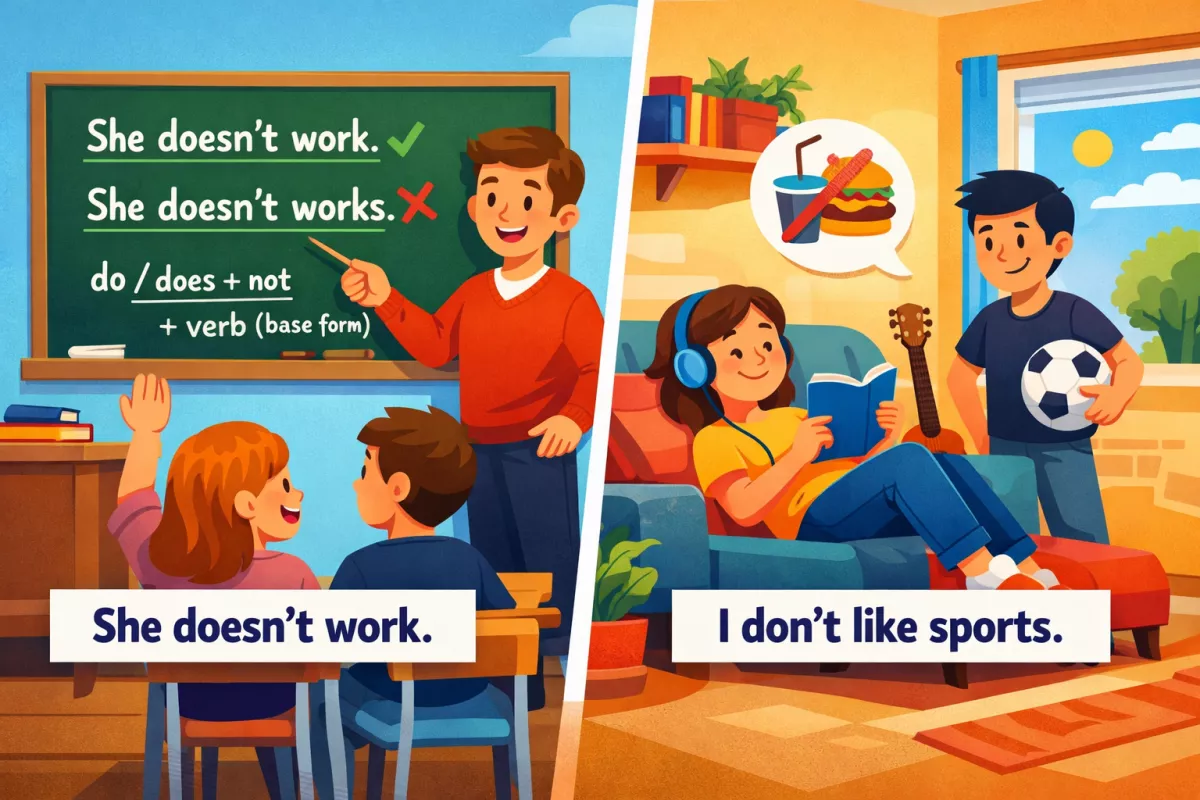
En las negativas aparece una de las claves más importantes del present simple: el auxiliar do / does junto con not. Aquí muchos estudiantes cometen el mismo error: añaden doesn’t y además dejan la -s en el verbo principal. Eso no se hace. Si ya has usado doesn’t, el verbo vuelve a su forma base: She doesn’t work, no “She doesn’t works”.
También conviene practicar con frases cotidianas, porque la negativa no sirve solo para “negar” hechos; sirve para hablar de hábitos que no tenemos, gustos que no compartimos o rutinas que no ocurren. Cuanto más real sea la frase, más fácil será recordarla.
Completa con don't o doesn't
- I ______ like spicy food.
- He ______ drive to work.
- They ______ live in this city.
- My mother ______ drink coffee.
- We ______ watch that series.
- It ______ open on Sundays.
- You ______ understand the question.
- Laura ______ play the piano.
- The boys ______ study French.
- My cat ______ sleep outside.
Mostrar respuestas
- don't
- doesn't
- don't
- doesn't
- don't
- doesn't
- don't
- doesn't
- don't
- doesn't
Pasa a negativa
- She works on Saturdays.
- I eat meat.
- They know the answer.
- He plays tennis after class.
- We live near the beach.
- My father drives at night.
- You speak German.
- The shop closes late.
- Anna likes cold weather.
- My friends visit us often.
Mostrar respuestas
- She doesn't work on Saturdays.
- I don't eat meat.
- They don't know the answer.
- He doesn't play tennis after class.
- We don't live near the beach.
- My father doesn't drive at night.
- You don't speak German.
- The shop doesn't close late.
- Anna doesn't like cold weather.
- My friends don't visit us often.
Completa la frase negativa correctamente
- She ______ (not / work) here.
- We ______ (not / have) enough time.
- He ______ (not / go) by train.
- I ______ (not / need) help.
- My sister ______ (not / eat) fish.
- They ______ (not / study) on Fridays.
- It ______ (not / rain) much here.
- You ______ (not / understand) me.
- Tom ______ (not / watch) the news.
- The children ______ (not / do) sport after school.
Mostrar respuestas
- doesn't work
- don't have
- doesn't go
- don't need
- doesn't eat
- don't study
- doesn't rain
- don't understand
- doesn't watch
- don't do
Ejercicios de preguntas
Las preguntas en este tiempo verbal exigen cambiar el orden normal de la frase. En lugar de empezar por el sujeto, usamos do o does al principio: Do you work here?, Does she live in London?. De nuevo, cuando aparece does, el verbo principal va sin -s. Esa es una regla pequeña, pero decisiva.
Es útil practicar tanto preguntas cerradas, que se responden con yes o no, como preguntas con palabras interrogativas: where, what, when, why, how often. Estas últimas son las que más usamos en conversación real, así que conviene perderles el miedo cuanto antes.
Ordena para formar preguntas
- you / do / coffee / like / ?
- she / does / work / here / ?
- they / live / do / nearby / ?
- he / does / play / football / ?
- your parents / do / travel / a lot / ?
- does / the film / start / at eight / ?
- we / do / need / tickets / ?
- does / your brother / cook / well / ?
- you / do / understand / this rule / ?
- does / it / rain / much / here / ?
Mostrar respuestas
- Do you like coffee?
- Does she work here?
- Do they live nearby?
- Does he play football?
- Do your parents travel a lot?
- Does the film start at eight?
- Do we need tickets?
- Does your brother cook well?
- Do you understand this rule?
- Does it rain much here?
Convierte a pregunta
- You work on Mondays.
- She studies English at home.
- They go to the gym.
- He likes sushi.
- Your sister drives to work.
- We have class at six.
- The shop open on Sundays.
- I need your help.
- Tom and Eva live together.
- It cost a lot.
Mostrar respuestas
- Do you work on Mondays?
- Does she study English at home?
- Do they go to the gym?
- Does he like sushi?
- Does your sister drive to work?
- Do we have class at six?
- Does the shop open on Sundays?
- Do I need your help?
- Do Tom and Eva live together?
- Does it cost a lot?
Una observación práctica: muchos alumnos saben la regla, pero al hablar tardan demasiado en aplicarla. Entrena con preguntas cortas y rápidas: “Do you like...?”, “Does he work...?”, “Do they live...?” hasta que el orden salga sin pensar.
Completa con do o does
- ______ you speak Italian?
- ______ she work in a bank?
- ______ they usually arrive early?
- ______ your father cook?
- ______ we have enough money?
- ______ it snow here in winter?
- ______ Marta study with you?
- ______ I need a reservation?
- ______ the children sleep early?
- ______ he remember your name?
Mostrar respuestas
- Do
- Does
- Do
- Does
- Do
- Does
- Does
- Do
- Do
- Does
| Tipo | Estructura | Ejemplo |
|---|---|---|
| Pregunta cerrada | Do/Does + sujeto + verbo base | Do they work here? (¿Trabajan aquí?) |
| Pregunta cerrada | Does + he/she/it + verbo base | Does she like tea? (¿Le gusta el té?) |
| Wh-question | Wh-word + do/does + sujeto + verbo base | Where do you live? (¿Dónde vives?) |
| Wh-question | Wh-word + does + he/she/it + verbo base | Why does he leave early? (¿Por qué se va temprano?) |
Uso de adverbios de frecuencia
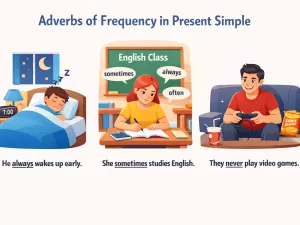
Cuando ya controlas afirmativas, negativas y preguntas, el siguiente paso natural es añadir matiz. Los adverbios de frecuencia permiten decir si algo ocurre siempre, a menudo, a veces o nunca. Son muy habituales en present simple porque este tiempo se usa precisamente para hablar de hábitos y rutinas. No basta con saber qué significan; hay que colocarlos bien dentro de la oración.
La regla práctica más útil es esta: normalmente van antes del verbo principal, pero después del verbo to be. Por eso decimos I usually get up early (normalmente me levanto temprano), pero She is always tired (ella siempre está cansada). Ese contraste merece práctica específica.
Coloca el adverbio en la posición correcta
- I go to bed late. (usually)
- She is happy after class. (always)
- They eat at home. (often)
- He drinks milk in the morning. (never)
- We are busy on Mondays. (sometimes)
- My father reads the newspaper. (every day / usually)
- You arrive early. (hardly ever)
- It is cold here in January. (often)
- Anna and Paul watch TV after dinner. (rarely)
- I am tired after work. (often)
Mostrar respuestas
- I usually go to bed late.
- She is always happy after class.
- They often eat at home.
- He never drinks milk in the morning.
- We are sometimes busy on Mondays.
- My father usually reads the newspaper every day.
- You hardly ever arrive early.
- It is often cold here in January.
- Anna and Paul rarely watch TV after dinner.
- I am often tired after work.
Completa con un adverbio de frecuencia adecuado
- I ______ brush my teeth before bed.
- She ______ goes to the cinema because she is very busy.
- We ______ have lunch together on Fridays.
- He ______ forgets his keys; it happens all the time.
- They ______ travel abroad because it is expensive for them.
- My teacher ______ gives us homework, almost every class.
- You are ______ late, maybe once or twice a year.
- It ______ rains in August here.
- My grandparents ______ walk in the park every morning.
- I ______ drink tea, but not every day.
Mostrar respuestas
- always
- rarely
- often
- always
- never / rarely
- usually / often
- hardly ever
- never / hardly ever
- always / usually
- sometimes
Fíjate en algo importante: algunos adverbios admiten más de una respuesta razonable si el significado encaja. En este tipo de ejercicio no solo importa la gramática, sino también la lógica de la frase. Esa flexibilidad es normal en el uso real del idioma.
Corrección de errores comunes
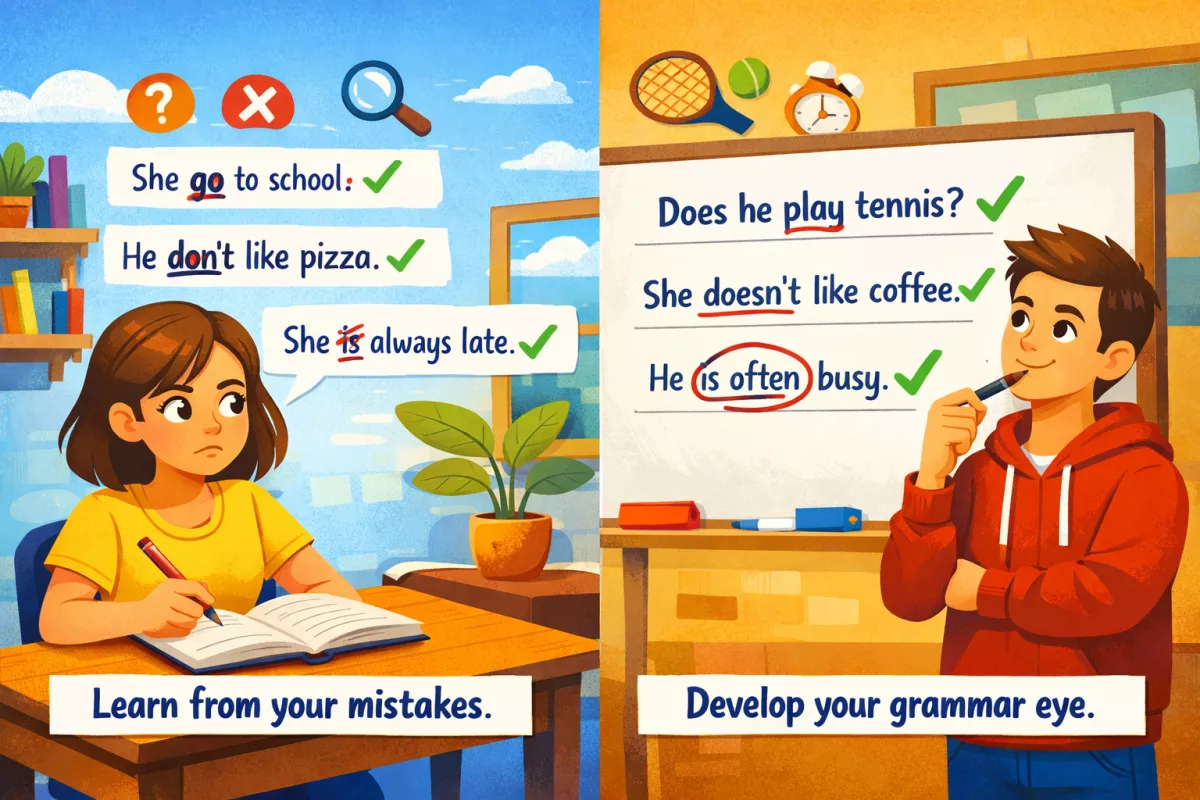
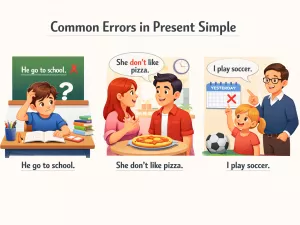
Corregir errores es una de las formas más eficaces de aprender, porque obliga a mirar la estructura con atención. En el present simple, los fallos más frecuentes suelen concentrarse en tres zonas: la tercera persona del singular, el uso de do/does en negativas y preguntas, y la colocación de adverbios de frecuencia. Si detectas esos patrones, avanzarás mucho más rápido que memorizando reglas sueltas.
En esta parte no se trata solo de “poner bien” una frase, sino de desarrollar ojo gramatical. Ese hábito te ayudará tanto al escribir como al hablar, porque empezarás a notar enseguida cuándo una construcción suena natural y cuándo no.
Corrige la frase
- She don't like chocolate.
- He go to work by train.
- Does Anna lives here?
- They doesn't study on Fridays.
- I am usually drink coffee in the morning.
- My brother watch TV every night.
- Do she play tennis?
- It don't open at nine.
- We goes to the beach in summer.
- He always is late.
Mostrar respuestas
- She doesn't like chocolate.
- He goes to work by train.
- Does Anna live here?
- They don't study on Fridays.
- I usually drink coffee in the morning.
- My brother watches TV every night.
- Does she play tennis?
- It doesn't open at nine.
- We go to the beach in summer.
- He is always late.
Identifica y corrige el error principal
- She doesn't works on Mondays.
- Do your father drive?
- My friends studies English online.
- He not like cold weather.
- Does they live in Seville?
- I never am tired in the morning.
- The dog sleep in the garden.
- We doesn't need more chairs.
- Does Marta goes to school here?
- You doesn't understand the exercise.
Mostrar respuestas
- She doesn't work on Mondays.
- Does your father drive?
- My friends study English online.
- He doesn't like cold weather.
- Do they live in Seville?
- I am never tired in the morning.
- The dog sleeps in the garden.
- We don't need more chairs.
- Does Marta go to school here?
- You don't understand the exercise.
Recomendación breve: cuando corrijas, no te limites a mirar la respuesta correcta. Pregúntate qué tipo de error era: ¿auxiliar incorrecto, verbo mal conjugado, orden equivocado? Ese análisis evita que repitas el mismo fallo.
Traducción de frases
Traducir bien no consiste en pasar palabra por palabra del español al inglés. Lo realmente útil es aprender a reconocer la estructura que pide el inglés. En presente simple, eso significa decidir si la frase es afirmativa, negativa o interrogativa, elegir bien el sujeto y aplicar la forma verbal adecuada. Muchas interferencias vienen del español, donde no usamos auxiliares para negar o preguntar de la misma manera.
Por eso, esta práctica está pensada para obligarte a tomar decisiones gramaticales. Algunas frases parecen sencillas, pero esconden detalles importantes: frecuencia, tercera persona, preguntas con auxiliar o negaciones con verbo base.
Traduce al inglés
- Yo trabajo desde casa.
- Ella no come carne.
- ¿Viven tus padres aquí?
- Mi hermano estudia por la noche.
- No vamos al gimnasio los lunes.
- ¿A qué hora empieza la película?
- Ellos siempre llegan temprano.
- Mi profesora no habla muy rápido.
- ¿Te gusta el café?
- Nunca cenamos fuera.
Mostrar respuestas
- I work from home.
- She doesn't eat meat.
- Do your parents live here?
- My brother studies at night.
- We don't go to the gym on Mondays.
- What time does the film start?
- They always arrive early.
- My teacher doesn't speak very fast.
- Do you like coffee?
- We never eat dinner out.
Traduce al español para comprobar el sentido
- She works in a hospital.
- Do they usually walk to school?
- He doesn't like noisy places.
- We often have dinner at eight.
- Does your sister play the guitar?
- I never forget birthdays.
- The train leaves at six.
- My friends don't watch TV in the morning.
- Why does he study so much?
- It rains a lot in spring.
Mostrar respuestas
- Ella trabaja en un hospital.
- ¿Suelen ir ellos caminando al colegio?
- A él no le gustan los lugares ruidosos.
- Nosotros cenamos a menudo a las ocho.
- ¿Tu hermana toca la guitarra?
- Nunca olvido los cumpleaños.
- El tren sale a las seis.
- Mis amigos no ven la tele por la mañana.
- ¿Por qué estudia tanto?
- Llueve mucho en primavera.
| Español | Patrón útil en inglés | Ejemplo |
|---|---|---|
| Yo no trabajo | I don't + verbo base | I don't work on Sundays. (No trabajo los domingos.) |
| Ella trabaja | She + verbo con s | She works nearby. (Ella trabaja cerca.) |
| ¿Trabajas...? | Do you + verbo base | Do you work here? (¿Trabajas aquí?) |
| ¿Trabaja ella...? | Does she + verbo base | Does she work here? (¿Trabaja ella aquí?) |
Práctica mixta de estructuras
Cuando ya has trabajado cada forma por separado, llega el momento más útil: mezclar estructuras. En la comunicación real no hablamos solo en afirmativas o solo en preguntas; vamos cambiando de una a otra según la intención. Esta práctica sirve para comprobar si realmente controlas el mecanismo completo del present simple sin depender de pistas demasiado evidentes.
Aquí conviene leer con calma y fijarse en el sujeto, el tipo de frase y la lógica del contexto. Si una misma actividad te obliga a afirmar, negar, preguntar y usar frecuencia, entonces estás entrenando el idioma de una forma mucho más cercana a la realidad.
Completa la estructura correcta
- She ______ (not / work) on Sundays.
- ______ your friends live near here?
- My father ______ (drive) to work every day.
- We ______ usually ______ (have) lunch at home.
- ______ he play the piano?
- I ______ (not / like) cold coffee.
- The shop ______ (close) at 8 p.m.
- ______ you often study at night?
- Anna ______ (watch) the news every morning.
- They ______ (not / go) out on weekdays.
Mostrar respuestas
- doesn't work
- Do
- drives
- do / have
- Does
- don't like
- closes
- Do
- watches
- don't go
Transforma según se pide
- She studies French. → negativa
- They don't eat fish. → afirmativa
- He works here. → pregunta
- We play tennis on Fridays. → negativa
- My sister doesn't drive. → pregunta
- I go to bed late. → pregunta
- It rains a lot in winter. → negativa
- You don't watch TV at night. → afirmativa
- Tom likes this song. → pregunta
- The children study after school. → negativa
Mostrar respuestas
- She doesn't study French.
- They eat fish.
- Does he work here?
- We don't play tennis on Fridays.
- Does my sister drive?
- Do I go to bed late?
- It doesn't rain a lot in winter.
- You watch TV at night.
- Does Tom like this song?
- The children don't study after school.
Escribe respuestas cortas
- Do you speak English?
- Does your mother work on Saturdays?
- Do they live in Spain?
- Does he like pizza?
- Do we need more water?
- Does the shop open early?
- Do I talk too fast?
- Does Marta study with you?
- Do the children sleep early?
- Does it rain much in summer?
Mostrar respuestas
- Yes, I do. / No, I don't.
- Yes, she does. / No, she doesn't.
- Yes, they do. / No, they don't.
- Yes, he does. / No, he doesn't.
- Yes, we do. / No, we don't.
- Yes, it does. / No, it doesn't.
- Yes, you do. / No, you don't.
- Yes, she does. / No, she doesn't.
- Yes, they do. / No, they don't.
- Yes, it does. / No, it doesn't.
Soluciones explicadas paso a paso
En esta última parte no vamos a repetir todas las respuestas anteriores, sino a analizar algunos modelos clave para que entiendas por qué son correctos. Ese “por qué” es lo que de verdad consolida el aprendizaje. Si comprendes el mecanismo, podrás resolver frases nuevas sin depender de la memoria inmediata.
He seleccionado ejemplos representativos de los errores y transformaciones más habituales. Léelos con atención y compáralos con tus propios fallos. Muchas veces el progreso en gramática no depende de estudiar más, sino de detectar exactamente en qué paso te equivocas.
Modelos de afirmativa
Tomemos la frase She studies English every day. El sujeto es she, así que el verbo necesita marca de tercera persona. Como study termina en consonante + y, la y cambia a ies: studies. No sería correcto decir “She study”.
Otro caso útil es He watches TV after dinner. Aquí el verbo termina en un sonido que suele pedir -es, no solo -s. Por eso aparece watches. Este patrón también se ve en goes, does y washes.
Modelos de negativa
Observa She doesn't work on Saturdays. La construcción tiene tres piezas: sujeto + auxiliar negativo + verbo base. El auxiliar doesn't ya indica tercera persona, así que el verbo principal vuelve a su forma simple: work. El error típico sería “She doesn't works”, porque marca la tercera persona dos veces.
En We don't live near the beach, el sujeto es we, así que usamos don't. Después va el verbo base live. Este esquema se repite con I, you, we, they: don't + verbo base.
Modelos de pregunta
Fíjate en Does she study English at home?. Para formar la pregunta, el auxiliar pasa al inicio: Does + sujeto + verbo base. Como ya usamos does, el verbo no puede llevar -s. Por eso decimos study, no “studies”.
Con Do they live nearby? ocurre lo mismo, pero con un sujeto plural. El orden es muy importante: primero el auxiliar, luego el sujeto y después el verbo. Un orden como “They do live nearby?” no es la forma normal de pregunta en este nivel.
Modelos con adverbios de frecuencia
En I usually go to bed late, el adverbio usually va antes del verbo principal go. Esa es la posición más frecuente en present simple. En cambio, en She is always happy, el verbo es to be, así que el adverbio se coloca después: is always.
Este contraste explica por qué He always is late suena incorrecto en el uso estándar. La forma natural es He is always late. Es un detalle pequeño, pero muy visible para cualquier hablante de inglés.
Modelos de traducción
Tomemos ¿A qué hora empieza la película? En inglés no traducimos palabra por palabra. La estructura correcta es What time does the film start?. Necesitamos does porque el sujeto es the film, y el verbo principal va en base: start, no “starts”.
Otro ejemplo: Nunca cenamos fuera. La solución natural es We never eat dinner out. Aquí no hace falta una negativa con don't, porque never ya expresa negación de frecuencia. Decir “We don't never...” sería incorrecto en inglés estándar.
Cómo revisar tus propias respuestas
Cuando corrijas un ejercicio de este tiempo verbal, revisa siempre en este orden:
- Identifica el sujeto: ¿es I/you/we/they o he/she/it?
- Decide el tipo de frase: afirmativa, negativa o pregunta.
- Comprueba si necesitas auxiliar: do o does.
- Si aparece does o doesn't, deja el verbo principal en forma base.
- Revisa la posición de adverbios como always, usually, often, never.
- Lee la frase completa en voz alta para comprobar si suena natural.
Si aplicas este proceso con constancia, dejarás de ver el present simple como una lista de reglas y empezarás a usarlo como una herramienta real para hablar de tu vida diaria, tus hábitos y tus rutinas con seguridad.